Many people use “blocked drain” and “sewer blockage” as if they mean the same thing, but they do not. The practical difference is usually where the blockage sits, who the pipe serves, and who is responsible for clearing it.
TL;DR: Summary
- A blocked drain usually affects a private drain serving one property within the property boundary, while a sewer blockage usually affects a shared or public sewer and may be the water company’s responsibility.
- In England, Ofwat states responsibility is usually split at the property boundary, a rule in place since 1 October 2011 for many drainage arrangements.
- If only one sink, toilet, or property is affected, the issue is more likely in a private drain; if several fittings or neighbouring properties are backing up, the problem is more likely in a shared drain, lateral drain, or public sewer.
- A CCTV drain survey can confirm the exact blockage location without excavation and can identify grease build-up, wipes, root intrusion, displaced joints, or collapsed pipe sections.
- If the blockage is inside your boundary and serves only your property, you will usually need a drainage contractor; if it is outside the boundary or affects shared pipework, contact your water company.
That distinction matters because it affects response time, access, and cost. It also stops a common mistake: calling a plumber for what is really a buried drainage fault. Or paying privately for a blockage that may sit in shared or public pipework.
What is the difference between a blocked drain and a sewer blockage?
In England and London, a blocked drain usually means a private pipe serving one property. However, a sewer blockage affects shared or public pipework. The key tests are location, who the pipe serves, and where it sits in relation to the property boundary.
A drain carries wastewater from one home or business. If that pipe runs only from your property and stays within your boundary, it is usually a private drain. A sewer carries wastewater from more than one property. Or it can do so from a single property once the pipe continues beyond the boundary as a lateral drain.
That is why the symptoms can look similar while responsibility is different. For example, a toilet backing up could be caused by a simple local blockage in a private drain. Alternatively, it could be caused by a downstream sewer restriction that affects several branch lines at once.
How can you tell whether the blockage is on your property or in the public sewer?
A quick check in Isleworth or Hounslow starts with scope. One affected fitting points towards a local drain issue. On the other hand, several fittings, an overflowing chamber, or affected neighbours point towards a sewer or shared drain problem.
Start inside. If only one sink or one toilet is slow, the blockage may be close to that appliance or branch line. Conversely, if the ground floor toilet, bath, and sink are all gurgling or backing up together, the restriction is usually further down the drainage run.
Next, check the nearest external inspection chamber if it is safe and accessible. If the chamber is full to the brim on your side but the next downstream chamber is empty, the blockage is likely between those two points. However, if multiple chambers are surcharged, the problem may sit further into shared pipework.
Then ask the simplest question most people skip: are the neighbours affected too? If the answer is yes, that strongly suggests a shared drain, lateral drain, or public sewer issue. So, it is less likely to be a private blockage within one property.
“DH Drainage Power uses CCTV drain surveys to show the exact blockage location without excavation.”
A common mistake is assuming that bad smells indoors always mean the public sewer is blocked. Smells can also come from a local trap, a cracked branch pipe, or a partially blocked private drain that has not yet caused a full overflow.
What checks and services best confirm whether it is a drain or sewer problem?
The most reliable answer usually comes from combining a safe chamber check with a CCTV drain survey and neighbour information. Water companies and CCTV-equipped drainage contractors each have a role. This depends on where the fault sits.
If the source is unclear, these checks and services usually give the quickest answer:
- DH Drainage Power or another CCTV-equipped drainage contractor: A CCTV drain survey can pinpoint blockages, cracks, displaced joints, root intrusion, and collapsed sections inside the buried pipe.
- Your water company’s sewer team: If neighbouring properties are affected or the issue appears outside the property boundary, they can check whether the public sewer is restricted.
- A safe inspection chamber check: Chamber water levels often show whether the blockage is upstream, downstream, or in a shared line.
- Neighbour confirmation and site layout review: Multiple homes connected to one run often means the blockage sits in shared drainage rather than one private drain.
This matters because the wrong first call can waste time. For example, if a contractor clears your internal waste pipe but the real restriction sits in the shared sewer beyond the boundary, the symptoms will come back quickly.
Who is responsible for clearing a blocked drain or sewer blockage in the UK?
In most UK cases, Ofwat says a private drain within your boundary is your responsibility. Shared or public sewer pipework is usually the water company’s responsibility. The property boundary is the main dividing line.
Ofwat( Water regulator in England & Wales) states that, since 1 October 2011, responsibility for many private sewers shifted so that the boundary is usually at the property boundary. In plain terms, a blockage in a private drain serving only your property is normally down to the owner or landlord. However, a blockage in a public sewer, or often in a lateral drain outside the boundary, is more likely to fall to the water company.
There are exceptions. Flats, mixed-use buildings, older conversions, and unusual site layouts can complicate ownership. That is why an exact location matters more than guesswork.
“DH Drainage Power offers free consultations and inspections when the responsibility line is unclear.”
A simple way to separate the terms is this:
- Private drain: serves one property within the property boundary, usually owner or landlord responsibility.
- Lateral drain: carries waste from one property outside the boundary towards the sewer, often water company responsibility.
- Public sewer: shared or adopted sewer, usually water company responsibility.
How does a CCTV drain survey pinpoint a sewer blockage without excavation?
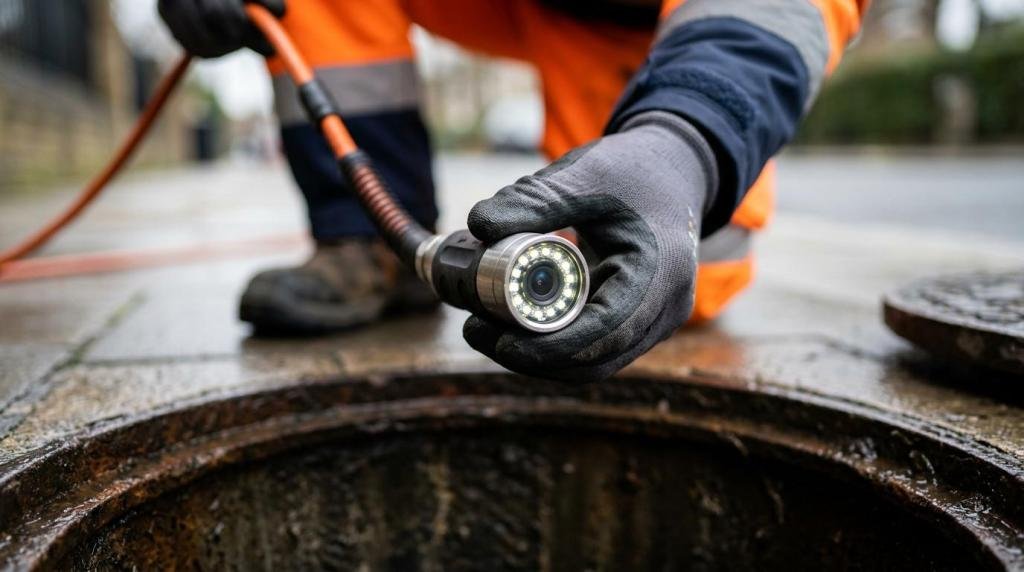
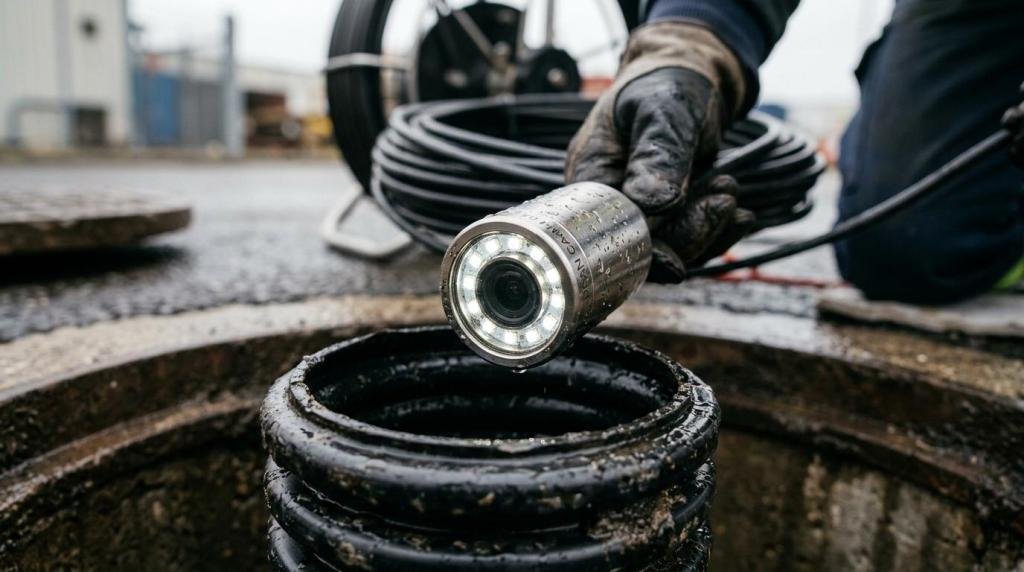
A CCTV drain survey uses a camera pushed through the pipe to show the blockage, its cause, and its exact position. In London, that often removes the guesswork before any excavation or repair decision is made.
The process is straightforward. An engineer accesses the line through a chamber or rodding point, feeds a camera through the drain, and records the condition of the pipe. The footage shows whether the problem is caused by wipes, fat, roots, a displaced joint, or a collapse.
The next step is location. A useful survey does not just show that a blockage exists. It also records where it sits in relation to chambers, branches, and the property boundary. That detail helps decide whether you need private clearance, a repair, or a call to the water company.
“DH Drainage Power reports the issue found, its severity and the exact pipe location.”
One misconception is that a CCTV survey only matters if the drain is already collapsed. In reality, it is most useful when symptoms are unclear, recurring, or disputed. This is because it can separate a routine blockage from a structural defect.
What usually causes a private drain blockage?
In homes across Richmond and Twickenham, private drain blockages are most often caused by wipes, fats, hair, soap residue, and sanitary products. In addition, older clay pipes can also suffer from roots, scale, and displaced joints.
Kitchen lines often block with fat, grease, and detergent residue. Meanwhile, bathroom lines tend to collect hair, wipes, and sanitary waste. Ground floor toilets are the fitting most likely to show the problem first. This is because they are closest to the buried drain run.
Recurring blockages in the same place often mean there is more than poor flushing habits involved. If the drain clears and then blocks again within weeks or months, a structural issue like a sagging pipe, root ingress, or a broken joint becomes more likely.
A common mistake is to blame only “too much toilet paper”. In practice, non-flushable wipes and grease are far more frequent culprits in severe blockages.
What usually causes a sewer blockage?
In Greater London, sewer blockages are commonly caused by wipes, fats, roots, silt, and damaged pipe sections in shared drainage runs. Because more than one property feeds the line, the build-up is usually heavier. As a result, the effects spread further.
Shared pipework collects waste from several homes or units, so misuse from one property can affect everyone downstream. Tree roots are another major factor. This is especially true where older joints allow moisture to escape and attract root growth.
Heavy rain can make a bad situation look worse, especially in areas with combined systems carrying foul water and surface water together. That does not always mean rain caused the blockage. It often means there was already a restriction and the extra flow exposed it.
If chambers in the street or several gardens are surcharging at the same time, treat it as a network issue until proven otherwise.
What should you do first when sewage backs up into a sink, toilet or manhole?
The first step is to stop using water immediately. In a home or shop in Ealing or Brentford, every extra flush or appliance cycle can push more sewage back through the lowest outlet.
Keep people away from the affected area and avoid contact with contaminated water. If electrical sockets, extension leads, or appliances are near the flooding, do not touch them until the area is safe. Then note which fittings are affected and whether the overflow is indoors, outdoors, or both.
If you can safely see the inspection chamber, check whether it is full. call a drainage contractor for urgent clearance and diagnosis.
“DH Drainage Power provides 24/7 emergency drain clearance for sewage back-up situations.”
Do not pour chemical cleaners into a surcharged drain. They rarely clear a buried blockage. In addition, they can create a hazard for anyone opening the pipework afterward.
Can you clear a blocked drain yourself or should you call a drainage engineer?
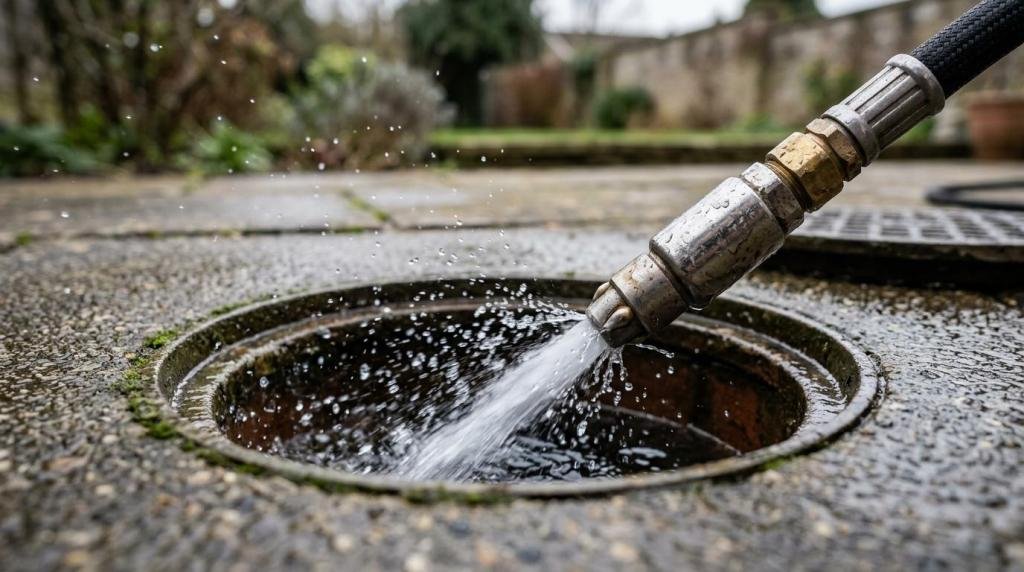
A simple sink trap blockage may be suitable for DIY, but an external drain, overflowing chamber, or recurring sewage backup needs a drainage engineer. Buried pipework usually needs jetting, rodding, or CCTV diagnosis rather than household products.
DIY works best when the issue is clearly local and minor, such as hair in a basin waste or a shallow kitchen trap blockage. A plunger or trap clean can solve that. Once sewage is backing up through a toilet, manhole, or gully, the blockage is usually deeper and often outside the reach of home tools.
There is a trade-off here. Trying the easy fix first can save money if the problem is near the fixture. However, pushing ahead with chemicals, improvised rods, or repeated flushing can make a deeper blockage worse, or at least messier.
If the same drain blocks more than once, skip the guesswork and get it checked properly. Repetition usually means the cause has not been removed.
When should you call your water company instead of a drainage contractor?
Call the water company when the blockage appears to affect shared or public sewer pipework. In places like Kingston or Uxbridge, that usually means neighbouring properties, downstream chambers, or pipework outside your boundary.
If several homes are reporting sewage backup, if a shared access chamber is overflowing, or if a CCTV survey shows the fault beyond the property boundary, the water company is the right next call. The same applies if the issue sits in a lateral drain outside the boundary.
If only your own fittings are affected and the blockage is inside the boundary, start with a drainage contractor. If the contractor then confirms the problem lies in adopted pipework, you can pass that evidence to the water company.
This is where clear records help. Photos of chamber levels, the survey report, and the marked location of the defect can speed up handover and reduce arguments over responsibility.
Why does the property boundary matter so much for drain and sewer problems?
The property boundary matters because it often decides who pays, who can authorise the work, and which team should attend first. Ofwat uses that boundary as the normal responsibility split for many drainage cases.
Without a confirmed location, people often pay for the wrong service. A contractor may clear a private section only to find the real problem sits outside the boundary. Or a resident may wait for the water company even though the blocked line serves only their own property.
The boundary also matters for access and repair method. If the defect is private and within your land, you can usually authorise jetting, patch lining, or excavation once the cause is known. However, if it is in public sewer infrastructure, the water company controls the response.
Can a blocked drain turn into a sewer blockage if you leave it too long?
A private blockage can worsen and affect more of the system, but it does not become a public sewer problem just because it gets worse. The legal distinction still depends on location, pipe type, and who the pipe serves.
What does change is the scale of the symptoms. A partially blocked private drain can collect solids, trap grease, and create standing wastewater. That puts more pressure on joints and may allow roots to exploit weak spots. If the affected line connects into shared drainage, the backup can then appear across more than one fitting or property.
So yes, delay can turn a small blockage into a bigger incident. It just does not change ownership by itself. Early diagnosis is usually cheaper than repeated clearances, contamination clean-up, or excavation after a collapse.