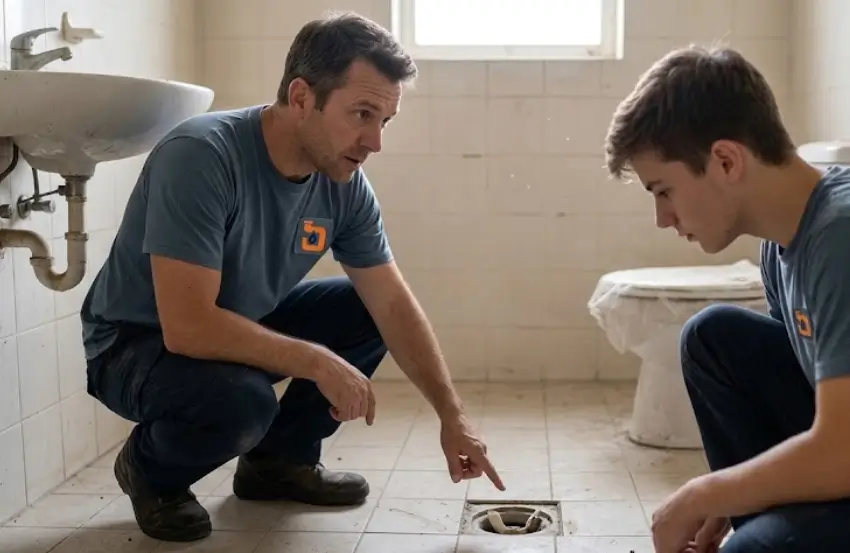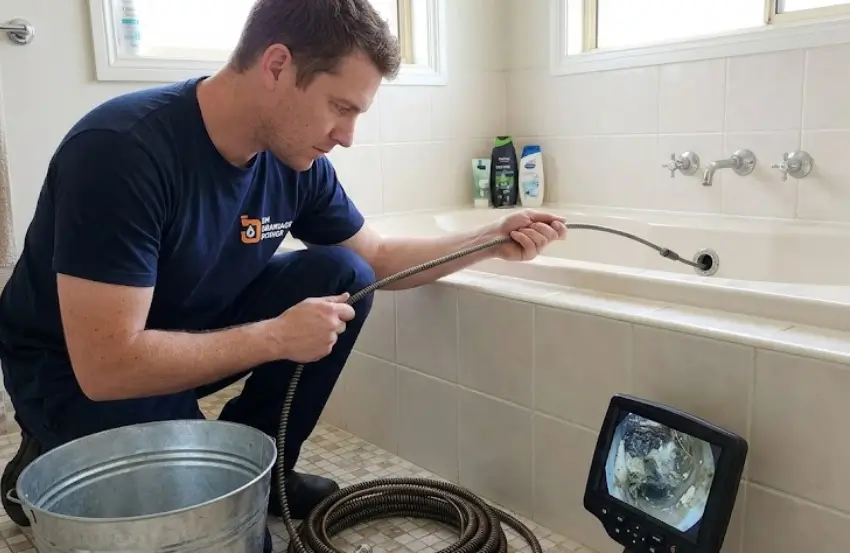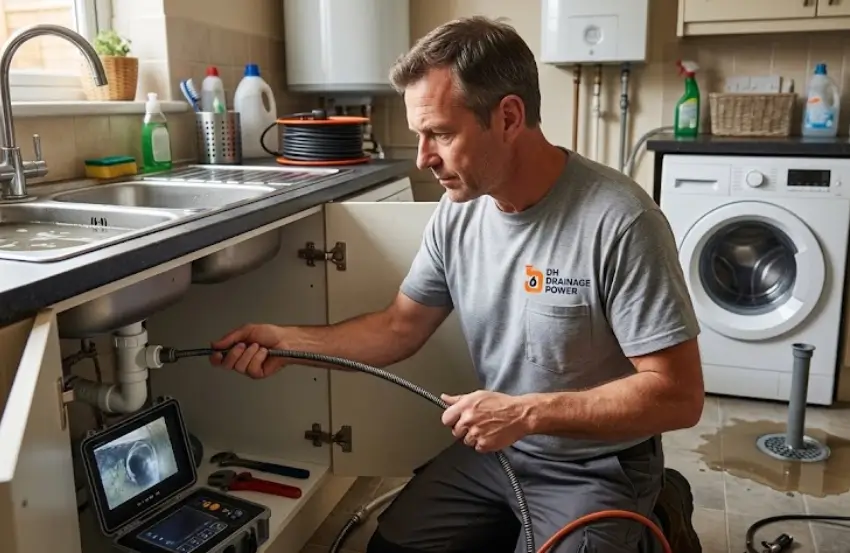
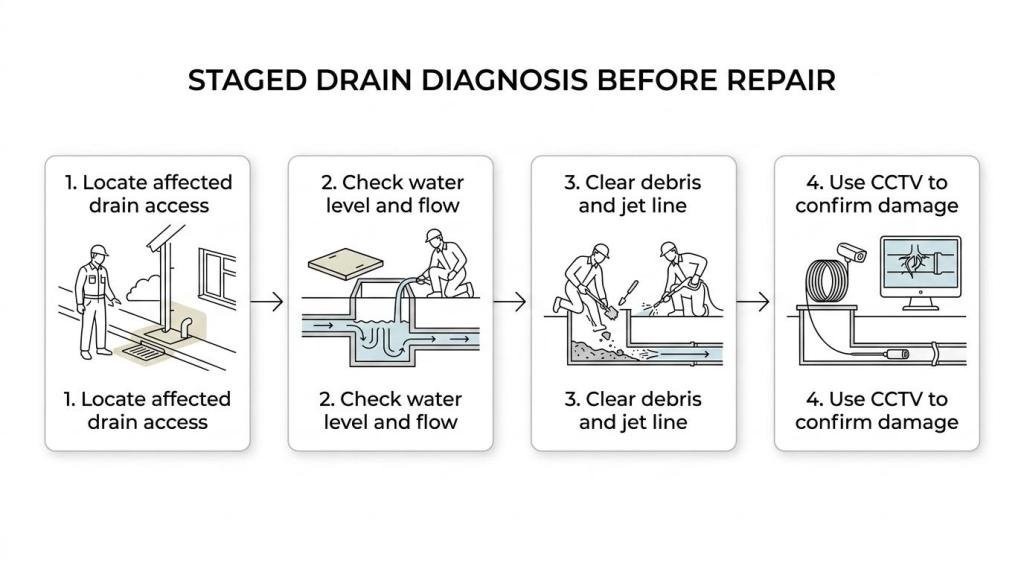
Drain fault finding begins with a straightforward principle: establish whether the problem is caused by restricted flow, a local blockage, or pipe damage before considering any repairs. On site, engineers start by checking access points and observing how water behaves in the system. They clear away any silt or debris where possible, then follow a staged approach using high-pressure water jetting and CCTV surveys to pinpoint the issue.
This methodical process is important because the initial hour on site often determines whether the job remains a simple clearance or escalates into a more involved repair investigation. Experienced engineers avoid making assumptions based solely on symptoms; instead, they systematically narrow down the fault using access chambers, gullies, rodding points, water testing, jetting, and camera inspections.
What does drain fault finding mean on site?
Drain fault finding means tracing the cause of poor drainage through the actual pipe route, not just treating the visible symptom. In London homes and commercial sites, engineers usually start with inspection chambers and gullies to establish where flow stops or slows.
The main aim is to separate three very different problems: a removable blockage, a service issue in the connected run, or a structural defect that needs repair. That distinction changes cost, urgency, and the right equipment. A sink backing up after grease build-up is a very different job from a line affected by root ingress or a displaced joint.
A common misconception is that fault finding begins with a camera every time. In practice, accepted site procedure often starts earlier than that: gain safe access, remove obvious debris, flush or test flow, then decide whether rodding, jetting, or CCTV gives the fastest reliable answer.
What do engineers check before they start jetting or using CCTV?
Engineers usually check access, flow behaviour, and immediate risks first. Manhole covers, inspection chambers, and nearby fixtures tell them whether the fault is upstream, downstream, internal, or shared.
Before any specialist equipment goes in, the first checks are practical. Is there safe access to the chamber? Is the cover buried, sealed, or obstructed? Is there standing water in the chamber, and if so, at what level compared with the inlet and outlet pipes? Those observations can show whether the blockage sits further downstream or whether the chamber itself is holding silt.
Welwyn Hatfield’s below-ground drainage specification reflects standard practice here: lift access covers, remove debris, and flush the system to remove silt and test for obstructions. That early housekeeping is not minor admin. It often makes the later CCTV footage clearer and prevents a camera from being pushed into avoidable debris.
“DH Drainage Power provides 24/7 emergency drain clearance, which matters when fault finding has to begin as soon as access is safe.”
What are the first on-site checks drainage engineers usually make?
The first checks are usually consistent across residential and commercial drainage work. Teams such as DH Drainage Power and other local specialists tend to work through a short priority list before deciding on clearance or survey methods.
After a quick site briefing, the first checks often look like this:
- DH Drainage Power and similar drainage teams start by confirming the symptom location, affected fixtures, and nearest access points.
- Water level check: engineers inspect the chamber to see whether water is static, surcharged, or flowing slowly.
- Access condition: covers are lifted where safe, and debris around manholes or inspection chambers is removed.
- Flow test: a controlled flush or fixture test helps show which run is slow or backing up.
- Initial clearance attempt: rods or jetting may be used if the blockage appears straightforward and reachable.
- Escalation decision: if flow does not restore, CCTV is used to identify roots, cracks, displaced joints, or broken connections.
That order saves time because it stops a team from using a camera blindly in a pipe full of silt or ragging. It also prevents the opposite mistake: assuming that all slow drainage is just a soft blockage when the chamber levels already suggest something more serious.
How do engineers test whether the fault is in a gully, branch, or main line?
Engineers usually isolate the drain run one section at a time. A gully, branch connection, and main line can all produce the same symptom, so the test sequence matters.
Step 1 is to identify which fixtures or surface inlets are affected. If one sink or one gully is slow, the problem is often local to that branch. If toilets, sinks, and external drains all struggle together, the fault is more likely downstream in a shared section.
Step 2 is chamber testing. The engineer opens the nearest inspection chamber and checks whether incoming pipes are discharging freely. If one inlet is backing up while the outlet channel runs clear, the fault is likely upstream on that branch. If the whole chamber is full and the outlet is submerged, the obstruction is usually further downstream.
Step 3 is a controlled water test or jetting pass. Shropshire Council notes that what looks like a blocked gully may actually be a problem in the piped system it connects to. That is a useful reminder: the visible opening is not always the failing part.
When is high-pressure water jetting enough, and when is CCTV needed?
High-pressure water jetting is often enough for soft blockages, while CCTV is usually needed for persistent or unclear faults. Jetting clears grease, silt, soap residue, and many routine obstructions, but it does not explain why the same drain keeps blocking.
Jetting is the right first move when the fault pattern suggests build-up rather than damage. A kitchen line with grease, an outside drain with silt, or a connection blocked by wipes may return to normal once the pipe walls are cleaned and flow is restored. Councils routinely describe jetting, emptying, and cleaning as standard drainage maintenance for that reason.
CCTV becomes the better choice when jetting fails, when the blockage returns quickly, or when the chamber observations do not match a simple obstruction. If the jetter passes but water still sits in the line, that points to backfall, deformation, root ingress, or a broken connection rather than loose debris alone.
“DH Drainage Power uses CCTV drain surveys and specialist equipment to separate simple blockages from structural drain defects.”
A useful rule is this: if a drain improves after clearance and stays clear, the fault was probably operational. If it improves briefly and then fails again, treat it as a possible pipe condition issue until the camera proves otherwise.
How do CCTV drain surveys confirm cracks, roots, or broken connections?
A CCTV drain survey confirms structural faults by showing the inside of the pipe in sequence between access points. Engineers can then match the visible defect to the exact run that needs repair or monitoring.
Step 1 is preparation. The line is usually flushed or jetted first so the camera sees pipe walls rather than silt, grease, or standing foul water. This is why many engineers do not lead with CCTV as the first action.
Step 2 is the survey pass. The camera is fed from one inspection chamber or rodding point to the next, recording material changes, joint positions, intrusions, and water levels. If roots are present, they often appear as fibrous ingress at joints. If a connection has failed, the image may show displacement, a lip, or open voids.
Step 3 is interpretation. A crack does not always mean immediate excavation, and that is where experience matters. Fine fractures may only need monitoring, while open joints, heavy root ingress, or repeated debris snagging normally point to targeted repair.
Is a recurring blockage different from a one-off blockage?
Yes, a recurring blockage is treated more seriously because it can signal a faulty pipe. Croydon Council explicitly notes that drains which keep blocking may suggest the pipes are defective.
A one-off blockage often comes from usage and debris. Grease, wipes, food solids, hair, and scale can all build up in ways that respond well to clearance. A recurring blockage, especially in the same location, changes the diagnosis. Tree root penetration, subsidence, and broken pipe sections become more likely.
The trade-off is straightforward. Repeatedly clearing the same drain may cost less today, but it can delay the real fix. A common mistake is assuming that a few weeks of good flow proves the pipe is sound. If the same line fails again, the cheaper path is often a survey before another reactive call-out.
How do engineers prepare manholes and inspection chambers for a proper survey?
Proper survey preparation is methodical. Manhole covers, inspection chamber covers, and access points need to be opened, cleaned, and checked before the camera work starts.
Step 1 is access preparation. Covers are lifted where safe, and debris around the chamber edge is removed so the engineer can inspect benching, channel condition, and incoming and outgoing pipes. Welwyn Hatfield’s specification is very clear on this point.
Step 2 is flushing and clearing. The system is flushed with water to shift silt and expose the true flow pattern. If flushing alone does not remove obstructions, the line is rodded or jetted between access points.
Step 3 is survey readiness. Once the chamber and line are visible enough, the engineer can run the CCTV unit with a much better chance of capturing usable evidence. Pro tip: poor preparation often creates poor footage, which can lead to uncertain repair decisions.
“DH Drainage Power handles residential and commercial drainage across London and nearby towns, with clear pricing and CCTV-based diagnosis when repeat faults need proof.”
What faults are most often found after the blockage is cleared?
The most common post-clearance faults are root ingress, displaced joints, cracks, backfalls, and broken connections. In clay and older mixed-material drains, root intrusion and joint movement are especially common.
Once flow is restored, the camera often reveals why the blockage formed in that spot. Roots trap paper and solids. A displaced joint catches wipes and scale. A backfall holds water and sediment instead of self-cleansing properly. In surface water systems, silted gullies and partially collapsed lateral runs are regular findings.
Many owners assume that if water is moving again, the job is finished. Sometimes it is. Still, when engineers see standing water left behind after jetting, that usually means the pipe geometry is wrong somewhere, not just dirty.
If then logic helps here. If debris was heavy but the pipe walls are sound, maintenance may be enough. If the obstruction was secondary to a crack or root entry point, repair planning becomes the sensible next step.
What should homeowners or property managers do before the engineer arrives?
Homeowners and property managers should make access easy, reduce water use, and gather fault history. Those three actions help the engineer diagnose the drain faster and with less disruption.
A few simple preparations can remove delays:
- Clear access: move bins, stored items, and parked vehicles away from inspection chambers, gullies, or external drain covers.
- Reduce flow: avoid repeated flushing, washing machine cycles, or heavy sink use if the system is already backing up.
- Share history: note when the problem started, whether it has happened before, and which fixtures are affected.
- Flag repairs: mention any past drain lining, excavation, extension work, or tree planting near the pipe route.
One misconception is that a strong chemical cleaner helps before the engineer arrives. It rarely helps with structural faults and can create handling risks at the chamber. Simple access and accurate information are far more useful.
How does drain fault finding change for commercial properties and shared drains?
Commercial and shared drains need wider tracing because the fault may sit beyond the visible affected unit. In a shop parade or block-managed property, one symptom can come from a shared line, interceptor, or downstream restriction.
The first difference is consequence. A blocked staff toilet in a café, a backed-up kitchen waste line, and a foul odour in a managed block all carry different urgency, hygiene, and access requirements. The second difference is ownership. A private branch, shared lateral, and public sewer do not fall under the same responsibility, so the fault location matters as much as the fault type.
Cambridgeshire County Council’s investigation model is useful here because it treats drainage work as staged: information gathering, jetting, CCTV, then design or remedial planning if needed. That mirrors good commercial practice. You clear what you can, prove what remains, then specify the least disruptive repair that fits the evidence.
In larger sites, the best fault finding is often less dramatic than people expect. It is careful chamber-by-chamber testing, good notes, clean footage, and a clear decision about whether the issue needs maintenance, repair, or referral to the relevant network owner.