Water rising into your kitchen sink whenever the washing machine empties is usually a warning that wastewater cannot flow freely through the connected drainage system. The most common explanation is a partial blockage in the sink waste pipe, shared drainage connection or downstream drain. In some cases, an incorrectly installed washing machine drain hose or inadequate waste pipe arrangement may also contribute. If you notice your sink backing up when washing machine drains, stop running the appliance until you understand what is causing the problem. Continuing to discharge water into a restricted pipe can lead to overflowing sinks, unpleasant smells and water damage around kitchen cabinets or flooring.
At DH Drainage Power, we provide residential and commercial drain clearance, fault finding and CCTV drain inspections across London and Greater London. Understanding whether the issue involves a local sink connection or a deeper drainage obstruction is an important first step towards choosing the right solution. This guide explains why washing machine wastewater can appear in your sink, how to recognise different warning signs, which checks are safe to attempt and when professional drainage assistance may be necessary.
How Can a Washing Machine Cause Your Sink to Back Up?
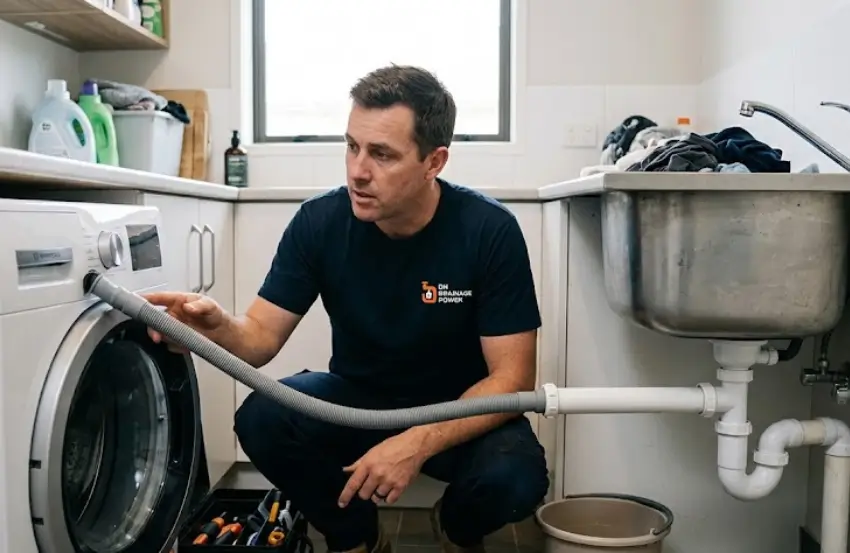
A washing machine removes used water through a drain pump and discharge hose. Depending on the plumbing arrangement, that hose may connect to a standpipe or a waste fitting associated with the kitchen sink.
When the appliance pumps out water, the connected waste pipe must carry that flow away.
If the pipe is restricted, water can accumulate faster than it escapes. Where the sink and washing machine share a drainage connection, the wastewater may rise into the sink instead.
Understanding a shared sink and washing machine waste pipe
Many kitchens and utility rooms have several appliances connected to the same downstream waste system.
The washing machine and sink may use separate branch connections before joining a common pipe. Alternatively, the appliance hose may connect through a suitable fitting beneath the sink.
Under normal conditions, water flows away without entering another fixture.
However, if grease, debris or sediment reduces the capacity of the shared pipe, the washing machine’s pumped discharge can temporarily overwhelm it.
Because the sink waste outlet connects to the same restricted section, water may return through the sink plughole.
Why does the problem happen during the drain cycle?
A kitchen tap normally introduces water at a relatively controlled rate. A washing machine, by comparison, pumps out collected wastewater during specific stages of its programme.
That concentrated discharge can reveal a developing blockage that ordinary sink use has not yet exposed.
For example, a sink might appear to drain normally while washing vegetables. Yet when the appliance starts emptying, the water level suddenly rises.
This difference is an important diagnostic clue: the downstream drainage connection may have insufficient capacity for the appliance discharge.
It does not automatically mean the washing machine itself is faulty.
What Causes a Sink to Back Up When the Washing Machine Drains?
Several plumbing and drainage problems can create similar symptoms. Identifying the likely cause requires looking at when the backup occurs, whether other fixtures are affected and whether the problem is recurring.
1. Grease and food waste blocking the sink waste pipe
Kitchen waste pipes can gradually accumulate fats, oils, grease, food particles and detergent residue.
As these materials collect along the pipe walls, the available space for wastewater becomes narrower.
The sink may still drain slowly, but the restricted pipe struggles when the washing machine releases a larger flow.
Water UK explains that cooking fats can solidify in cooler pipes and increase the risk of serious blockages, even when hot water or washing-up liquid is used.
This is particularly relevant where the washing machine shares drainage pipework with a frequently used kitchen sink.
2. A blockage further along the shared drain
Sometimes the sink trap and nearby pipework are clear, but the problem exists further downstream.
A blockage at the shared connection can restrict drainage from multiple appliances and fittings.
Clues include:
-
Water rising in the sink whenever the washing machine empties.
-
The sink draining slowly even when the appliance is off.
-
Gurgling from nearby plugholes.
-
Unpleasant smells from the kitchen drain.
-
Water returning after an initial attempt to clear the blockage.
If several fixtures are affected, investigate the shared drainage route rather than assuming the sink trap is the only problem.
3. Incorrect washing machine drain hose installation
A poorly positioned discharge hose can also cause drainage problems.
For example, a hose may be inserted incorrectly into a standpipe, may be kinked or may not be properly connected to an appropriate waste fitting.
Incorrect installation can interfere with wastewater discharge or allow water to escape at the connection.
The correct hose height, insertion depth and arrangement depend on the appliance manufacturer’s instructions and the plumbing installation.
If the problem began immediately after installing or moving a washing machine, ask a qualified appliance installer or plumber to check the connection.
4. An overflowing washing machine standpipe
A standpipe is the upright waste pipe into which a washing machine drain hose may discharge.
It is designed to accept wastewater and carry it to the drainage system.
If the standpipe overflows, possible causes include a downstream blockage, an unsuitable pipe arrangement or a discharge connection that does not meet the appliance requirements.
An overflowing standpipe is not necessarily the same as wastewater backing up through the sink.
However, both symptoms can be connected to insufficient drainage capacity.
Avoid sealing the hose into an overflowing standpipe or forcing it further into the pipe as a makeshift solution.
5. Damaged or obstructed downstream drainpipes
Not every recurring blockage comes from ordinary waste build-up.
Depending on the drainage layout, a deeper problem may involve:
-
Root intrusion into underground drains.
-
Damaged or displaced pipe joints.
-
Heavy deposits restricting wastewater flow.
-
Cracked or collapsed drainage sections.
These faults are less likely to be diagnosed simply by looking beneath the sink.
Where the symptoms suggest an underground drainage problem, a professional inspection may be appropriate.
DH Drainage Power offers CCTV drain inspections in London to help investigate suitable accessible drainage pipes and identify hidden defects.
How Can You Identify the Cause of Washing Machine Drain Backflow?
Different warning signs point towards different parts of the drainage system.
The following table can help you decide what to check and when to seek assistance.
| Warning sign | Possible cause | Recommended action |
|---|---|---|
| Sink fills only during washing machine discharge | Restricted shared waste pipe | Stop the appliance and check for visible overflow |
| Sink drains slowly throughout the day | Grease or debris near the sink | Inspect accessible plughole and trap areas safely |
| Standpipe overflows during pumping | Downstream restriction or unsuitable connection | Stop using the appliance and request a plumbing assessment |
| Water leaks beneath the sink | Loose or poorly fitted waste connection | Stop water use and arrange a connection check |
| Several fixtures gurgle or drain slowly | Possible shared drainage obstruction | Consider professional drain fault finding |
| Backflow returns after clearing | Persistent obstruction or damaged pipe | Arrange further investigation |
| Foul wastewater enters multiple fixtures | More extensive drainage problem | Avoid using affected drains and seek urgent assistance |
The table provides possible explanations rather than a confirmed diagnosis. Similar symptoms can have different causes depending on the property layout.
What Should You Do Immediately When Your Sink Backs Up?
The priority is to prevent additional wastewater from entering the affected drainage system.
Step 1: Stop the washing machine safely
If water begins rising in the sink, pause or stop the washing machine using its normal controls.
Avoid starting another wash cycle until the drainage issue has been assessed.
If water is approaching electrical sockets, plugs or appliances, avoid entering the wet area or touching electrical equipment. Seek appropriate emergency assistance.
Step 2: Avoid using connected fixtures
Do not continue running the sink or dishwasher if they share the affected waste pipe.
Adding more water may cause the sink to overflow or push wastewater through a different connection.
Where several fixtures are backing up, limit water use elsewhere in the property until the fault is located.
Step 3: Check for visible obstructions
Look for food debris, residue or other material around the sink plughole.
If accessible, remove and clean the sink strainer.
Do not dismantle concealed plumbing, disconnect appliance hoses or disturb pressurised or electrical connections unless you are competent to do so safely.
Step 4: Inspect for obvious leaks
Check whether water is escaping from visible pipe connections or beneath kitchen cupboards.
A leak can indicate a separate fitting problem, even when the sink also drains poorly.
Place a container under an active drip if safe, but do not continue running appliances to test whether the leak has stopped.
Step 5: Contact a drainage specialist if the issue persists
If the sink repeatedly fills during the washing machine’s drain cycle, the problem may be beyond an easily accessible obstruction.
Professional drain unblocking in London can help when a blockage is suspected within the drainage system.
Explain exactly which appliance triggers the backup, which fixtures are affected and whether the problem has happened before.
Can You Fix a Washing Machine and Sink Drain Blockage Yourself?
Minor obstructions near an accessible sink opening may sometimes be manageable without specialist equipment.
However, it is important to distinguish simple cleaning from attempting to clear deeper pipework.
Safe tasks you may be able to attempt
-
Remove food scraps from the sink strainer.
-
Clean visible residue around the plughole.
-
Check whether a washing machine hose is visibly kinked, without pulling or disconnecting it.
-
Inspect accessible fittings for signs of leakage.
-
Review the appliance manufacturer’s drainage installation guidance.
-
Record which fixtures are affected and when the problem occurs.
These checks may help identify obvious issues without unnecessarily disturbing the plumbing.
What should you avoid?
Do not mix chemical drain cleaners, bleach or other cleaning products.
Avoid pouring large quantities of boiling water into plastic waste pipes, forcing tools into concealed pipework or repeatedly running the washing machine to test a suspected blockage.
Chemical products may create additional hazards for anyone investigating the pipework later.
If wastewater contains sewage or other contaminants, avoid direct contact and keep children and pets away from the affected area.
For wider drainage problems, review the company’s advice on preventing blocked kitchen and bathroom sinks.
Why Might Your Toilet Gurgle or Shower Back Up at the Same Time?
When multiple fixtures begin behaving unusually, the issue may extend beyond the kitchen waste pipe.
For example, someone might notice that their toilet gurgles when shower drains while the kitchen sink also struggles to empty.
This combination can suggest a restriction in shared drainage pipework or an air movement problem.
What causes gurgling in connected drains?
Gurgling generally occurs when air moves through water in the drainage system in an unusual way.
A partial blockage can alter water and air movement, creating bubbling sounds in nearby fixtures.
However, venting problems can produce similar symptoms, so gurgling alone does not confirm a blockage.
Does shower water backing up into a toilet indicate a main blockage?
If someone reports a shower backing up into toilet or water appearing at another low-level fixture, the connecting drain may be restricted.
The exact pathway depends on the property’s plumbing layout.
A gurgling toilet and blocked shower drain occurring alongside sink backflow is a stronger reason to investigate the wider drainage system.
Thames Water identifies slow drainage, difficult toilet flushing, bad smells and wastewater returning through fixtures as potential blockage indicators.
Because these symptoms may involve more than one drain, avoid treating each fixture as an isolated problem.
How Do Professionals Investigate Washing Machine Drainage Problems?
The correct investigation depends on whether the fault is within the appliance connection, the sink waste pipe or the broader drainage system.
Initial assessment and symptom review
A drainage specialist may begin by asking:
-
Does the sink back up only when the washing machine runs?
-
Does the sink drain normally at other times?
-
Has the appliance recently been installed or moved?
-
Are other sinks, toilets or showers affected?
-
Is there an overflowing external gully?
-
Has a similar problem happened previously?
These details help narrow down the probable obstruction location.
Clearing accessible drainage obstructions
Where the fault involves a blocked drain, suitable clearance techniques may include mechanical equipment or water jetting, depending on the pipe’s condition, location and access.
Not every method is appropriate for every pipe. Smaller indoor appliance connections require different consideration from larger underground drainage runs.
DH Drainage Power provides kitchen drain clearance services in London for relevant kitchen drainage blockages.
When is a CCTV drain survey useful?
If the problem continues after suitable clearance, or several connected fixtures remain affected, an inspection may help establish whether there is a deeper obstruction or damaged drainage pipe.
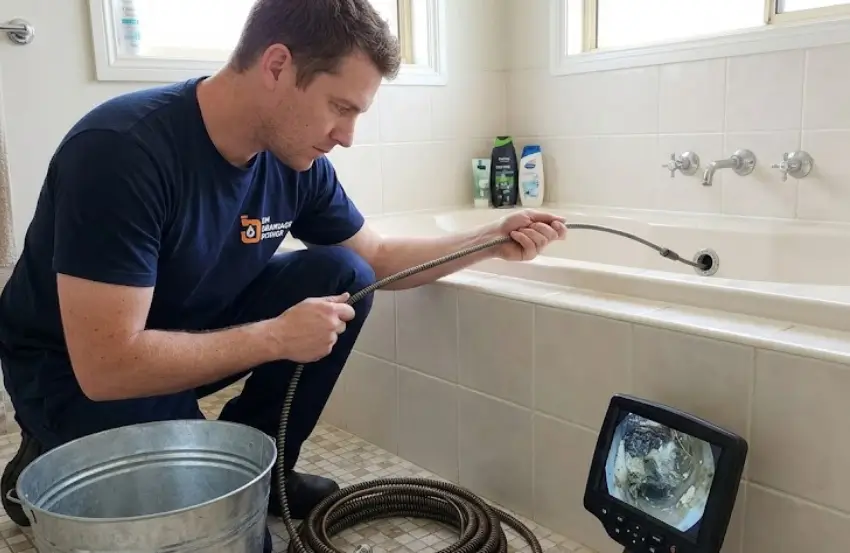
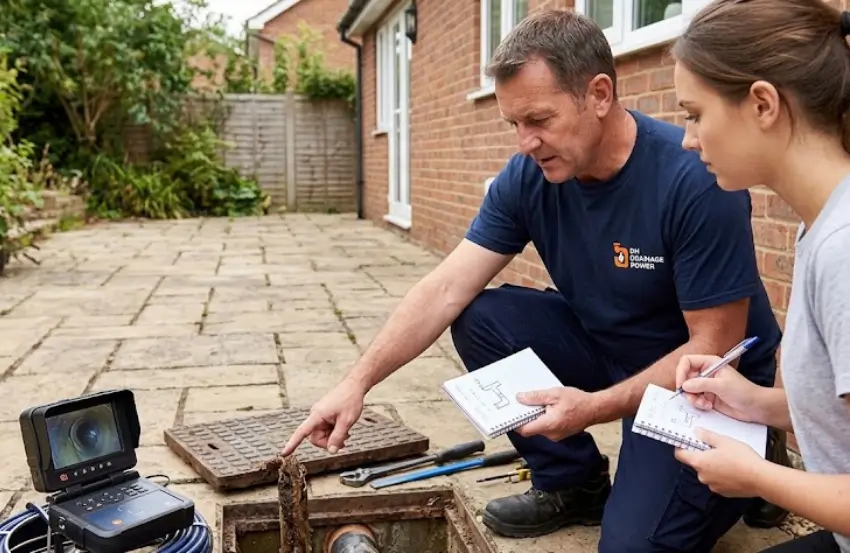
CCTV equipment can be used in suitable drain sections to investigate issues such as root ingress, displaced joints and structural defects.
It is not normally the first tool for a simple washing machine discharge hose fault or a small sink trap.
The objective is to identify the actual fault before deciding whether further drain clearance, repair work or separate plumbing assistance is needed.
How Can Landlords and Businesses Manage Washing Machine Backflow?
Laundry-related wastewater problems can create disruption beyond a single household.
For landlords and property managers, documenting when the problem occurs helps determine whether it involves one appliance, a shared internal waste connection or a larger drainage route.
Where multiple flats use connected drainage pipework, investigating which fixtures are affected can help locate the problem.
Commercial property owners should also pay attention to utility rooms, staff laundry facilities and any shared wastewater connections.
If repeated discharge causes overflow, continued appliance use could expose stock, flooring or fixtures to water damage.
Useful management measures include recording previous blockages, ensuring occupants report slow drainage promptly, checking whether appropriate preventative maintenance is needed and keeping access to relevant drainage inspection points clear.
In rented or multi-occupancy premises, responsibility for repairs depends on the tenancy arrangements, pipe ownership and applicable law. Do not assume the person using the appliance must automatically pay for drainage repairs.
How Can You Prevent Washing Machine Water from Backing Up?
Preventative maintenance reduces the likelihood of avoidable restrictions.
Keep fats and food waste out of kitchen drains
Dispose of leftover cooking fats and oils appropriately rather than pouring them down the sink.
Use a sink strainer and scrape food scraps into the appropriate waste container.
Grease is particularly troublesome in shared kitchen wastewater pipes because deposits can gradually reduce the available drainage capacity.
Maintain your washing machine correctly
Follow the manufacturer’s instructions for cleaning accessible filters and maintaining the appliance.
Avoid overloading the machine or using excessive detergent.
Ensure the discharge hose remains in its intended position and check visible connections for leaks or damage.
If you suspect an installation fault, arrange an appropriate plumbing or appliance assessment.
Respond to early warning signs
Do not ignore repeated sink gurgling, unusually slow drainage or small amounts of water rising during the washing machine’s discharge cycle.
These symptoms may appear before a complete obstruction develops.
Seek professional advice when the symptoms persist or spread to other fixtures.
Consider the condition of the property’s drainage system
Some London properties have older or altered drainage arrangements, while converted buildings may contain multiple waste connections.
Age alone does not prove a fault, but modifications, damaged pipework and poorly arranged connections can contribute to recurring drainage issues.
A targeted assessment is more useful than assuming that every property requires frequent chemical cleaning.
Who Is Responsible if the Blockage Is in a Shared Drain?
Responsibility depends on the location and ownership of the affected pipe.
An obstruction in an internal sink waste connection will generally be dealt with through the property’s plumbing or maintenance arrangements.
For underground drains and shared sewers, ownership may be different.
Thames Water explains that property owners are generally responsible for private drainage, while the sewerage company maintains the public wastewater network and may be responsible for qualifying shared or lateral sewers.
If several neighbouring properties experience drainage problems, contact the relevant sewerage provider to establish whether the fault may involve its network.
For homes and businesses in London, DH Drainage Power can assist with suspected private drain blockages and related drainage fault finding.
Frequently Asked Questions
1. Why does my kitchen sink fill up when the washing machine drains?
Your kitchen sink may fill because the washing machine pumps wastewater into a pipe that cannot carry it away quickly enough. A partial blockage in the shared waste connection is a common cause. Grease, food debris or other deposits can restrict the pipe. If the problem repeatedly occurs during the drain cycle, the connected pipework should be checked.
2. Can a washing machine cause a kitchen sink to overflow?
Yes. When a washing machine and kitchen sink share drainage pipework, the machine’s pumped discharge can cause wastewater to return through the sink if the downstream pipe is obstructed. An unsuitable waste connection may also contribute. Stop using the appliance when water starts rising and investigate the drainage arrangement before restarting it.
3. Why is my sink gurgling when the washing machine drains?
Gurgling may occur when wastewater and air struggle to move normally through connected pipes. A developing blockage or a drainage venting issue can cause unusual bubbling noises. If the sink also drains slowly or wastewater rises into the bowl, an obstruction becomes more likely. Persistent symptoms should be investigated rather than repeatedly tested.
4. Can a blocked washing machine drain affect my toilet or shower?
It depends on the property’s plumbing configuration. A blockage confined to the washing machine waste pipe would not normally affect an unrelated toilet connection. However, if the obstruction is further downstream in shared drainage pipework, several fixtures may develop problems. Toilet gurgling, shower backflow and sink drainage failures occurring together warrant a broader drainage assessment.
5. Is washing machine water backing up into the sink an emergency?
Not every instance requires emergency drainage assistance, but active overflowing, sewage contamination or water approaching electrical equipment should be treated urgently. Stop the affected appliance and avoid using connected fixtures. If the water cannot drain or multiple fixtures are affected, contact a suitable drainage professional. DH Drainage Power provides 24/7 emergency drainage support across its service areas.
6. Will drain cleaner fix a sink backing up from a washing machine?
Chemical drain cleaners are not a reliable solution for every blockage, particularly when the restriction is deep within shared drainage pipework. They may also create handling hazards and complications for subsequent professional clearance. Avoid mixing cleaning chemicals. If accessible debris removal does not resolve the problem, professional assessment can identify a more appropriate solution.
7. When should I book a CCTV drain survey for recurring backflow?
A CCTV drain survey may be appropriate when repeated blockages suggest a problem in accessible underground drainage pipework, particularly where there are signs of damaged joints, root intrusion or recurring restrictions. It is not normally necessary for a simple appliance hose or sink trap fault. An initial assessment should establish whether CCTV inspection would provide useful information.
Conclusion: Stop Washing Machine Drain Backflow Before It Gets Worse
A sink backing up when the washing machine drains often indicates restricted wastewater flow through shared pipework. Grease deposits, local blockages, unsuitable drainage connections and deeper obstructions are among the possible causes.
The most important action is to stop using the affected appliance, prevent further overflow and identify whether the problem is localised or affecting multiple fixtures.