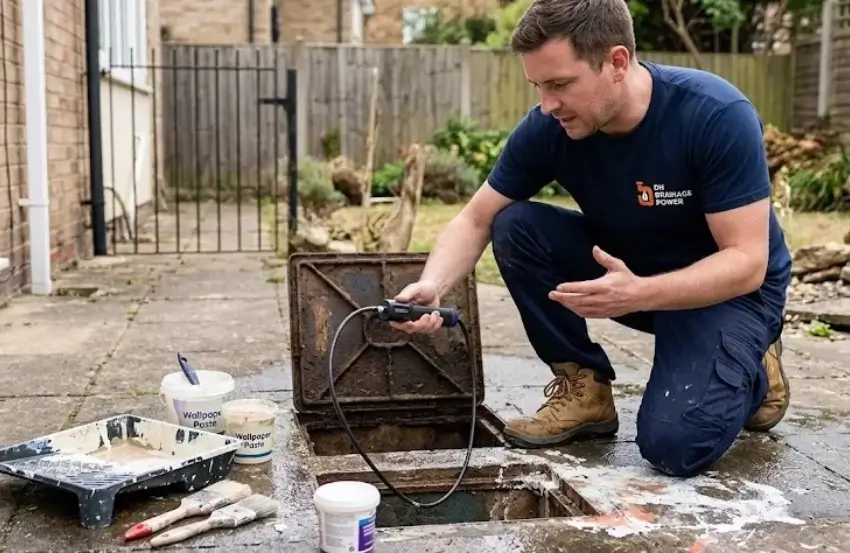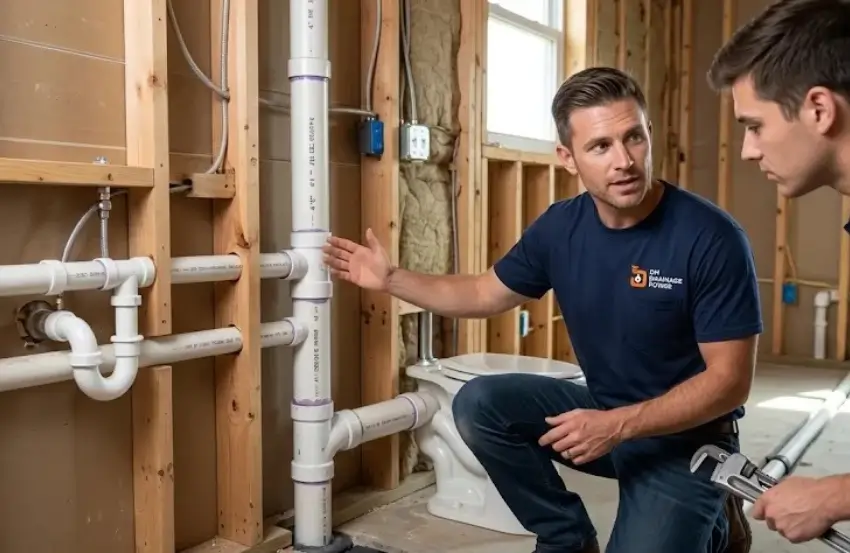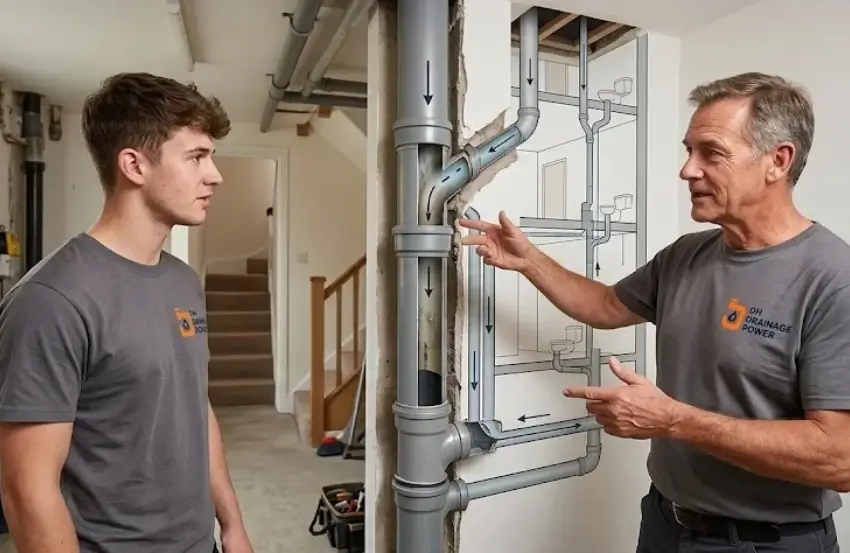
A CCTV drain survey can reveal problems inside underground pipework, but the camera needs a reasonably clear route and sufficient visibility to assess the drain properly. That is why drain cleaning before CCTV survey work may be necessary when grease, silt, debris or an obstruction prevents the camera from travelling through the pipe or obscures its internal surface.
However, cleaning is not automatically required before every survey. A camera inspection may be useful before clearance when the aim is to identify an obstruction or investigate why wastewater is not flowing correctly. For a detailed assessment of pipe condition, removing deposits first can make cracks, displaced joints and other defects easier to see.
DH Drainage Power provides drain clearance and CCTV drain inspection services for residential and commercial properties across London and surrounding areas. The appropriate sequence depends on the symptoms, available access and condition of the drainage system.
For homeowners, landlords and businesses, understanding this distinction helps prevent unnecessary work and improves the usefulness of the inspection. The essential question is whether the camera can see and assess the problem accurately before any cleaning takes place.
Why Might Drain Cleaning Be Necessary Before a CCTV Survey?
A CCTV drain camera records the visible interior of a drainage pipe. Its usefulness depends on the operator being able to move the camera through the relevant section and obtain a sufficiently clear picture of the pipe walls, joints and base.
Accumulated material can interfere with either requirement. A drain may still carry wastewater while leaving significant deposits along its internal surface. Those deposits can conceal damage or make it difficult to distinguish between a structural problem and a maintenance issue.
Cleaning may therefore be recommended to:
- Remove obstructions preventing the camera from progressing.
- Expose pipe surfaces hidden beneath grease or sediment.
- Improve visibility around joints and changes in pipe condition.
- Allow a more complete examination of accessible pipe sections.
- Help distinguish remaining structural defects from removable deposits.
The Water UK guidance on fatbergs and sewer blockages explains how wipes, fats, oils and grease combine to obstruct drainage systems.
However, removing deposits before recording their position may also remove useful evidence. The purpose of the survey should therefore influence the decision about cleaning.
What Can Prevent a CCTV Camera from Inspecting a Drain Properly?
Several types of obstruction and deposit can limit an inspection. Some prevent camera movement, while others allow the camera to pass but obscure important details.
1. Fat, Grease and Detergent Build-up
Cooking fats, oils and grease can collect along internal pipe surfaces, particularly where wastewater cools and deposits begin to harden.
Food particles and other materials may attach to these deposits, progressively narrowing the available passage.
A camera might travel through the remaining opening without revealing the true condition of the pipe underneath.
Cleaning may be needed to expose the pipe wall, particularly when the survey is intended to investigate recurring restrictions rather than simply establish whether the pipe is open.
2. Silt, Sand and Sediment
External drainage systems can accumulate silt, soil and small particles carried by rainwater or other flows.
Sediment may settle along the bottom of a pipe, especially where water movement is restricted.
During an inspection, this material can conceal the pipe invert — the lowest internal surface through which wastewater normally flows.
A surveyor may need to document the sediment before deciding whether removing it would improve the inspection.
Recurring sediment can also indicate a drainage issue that warrants further investigation.
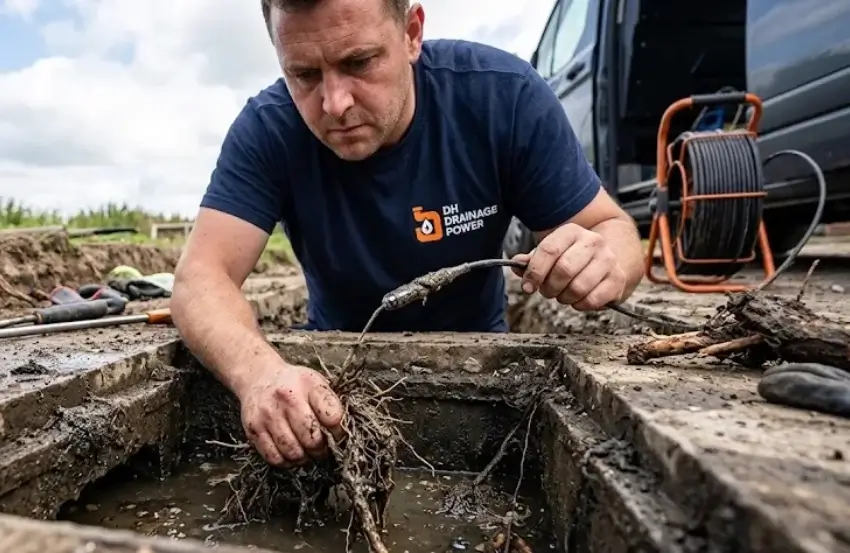
3. Tree Roots Inside Drainage Pipes
Roots may enter through damaged joints, cracks or other openings and grow within the available space.
Even relatively small root growth can trap toilet paper, debris and other material.
A CCTV camera may identify the presence of roots but be unable to pass through a substantial mass.
Depending on the condition of the pipe, specialist root removal may allow a subsequent survey to examine the affected section more thoroughly.
However, removing roots does not necessarily resolve the opening that allowed them to enter.
4. Solid Blockages and Foreign Objects
A compacted blockage can stop the camera before it reaches the section requiring investigation.
Potential obstructions include wipes, sanitary products, accumulated waste and objects that should not have entered the drainage system.
An initial camera inspection may help establish where the obstruction begins. Clearance might then be necessary before the remaining pipe can be assessed.
Professional assessment is especially important where an obstruction could be associated with pipe damage or restricted access.
5. Standing Wastewater
A camera cannot provide the same level of visual detail through standing or heavily contaminated wastewater as it can in a sufficiently clear pipe.
Standing water may result from a downstream blockage, poor drainage gradient or another restriction.
Cleaning alone may not resolve the underlying cause.
The surveyor should consider whether the water level is temporarily elevated, whether flow is restricted and whether further investigation is needed.
Do Drains Always Need Cleaning Before a CCTV Inspection?
No. A drain does not always need cleaning before a CCTV survey. The decision depends on the purpose of the inspection and whether deposits or obstructions are preventing a useful assessment.
For example, an initial inspection of a partially blocked drain may reveal how waste has accumulated and where the obstruction is located.
Cleaning beforehand could remove this evidence.
Conversely, a survey intended to assess structural condition may require the pipe walls to be sufficiently exposed for defects to be identified.
A practical approach is to distinguish between an initial investigation and a detailed condition survey.
When an Initial CCTV Inspection May Come First
An inspection before cleaning may be appropriate when:
- The cause or location of a blockage is unknown.
- Deposits need to be documented before removal.
- There is concern about a severely damaged section of pipe.
- The camera can safely enter and inspect the affected area.
- The objective is to understand why an obstruction keeps returning.
When Cleaning Before the Main Survey May Be Better
Cleaning may be appropriate when:
- Grease or silt hides much of the internal pipe surface.
- A blockage prevents the camera reaching the intended area.
- An inspection is required to assess pipe condition after clearance.
- The accessible pipe contains deposits that would make observations unreliable.
- The surveyor needs to determine whether a visible problem remains after removable waste has been cleared.
The important distinction is that drain cleaning prepares the pipe for inspection, while a CCTV survey examines its visible condition. They serve different purposes and are not interchangeable.
Drain Cleaning Before CCTV Survey: When Is It Needed?
The following table explains how different drainage conditions may influence the inspection process.
| Drain condition | Is cleaning likely to help? | Recommended approach |
|---|---|---|
| Clear, freely flowing drain | Often unnecessary | Proceed with the planned CCTV survey |
| Heavy grease deposits | Often | Assess deposits and clean where they obscure the pipe |
| Significant silt accumulation | Often | Document the accumulation, then consider cleaning |
| Complete blockage | Usually required for inspection beyond the blockage | Locate or assess the obstruction, clear it safely, then inspect further |
| Suspected cracked pipe | Depends on condition | Assess damage risk before selecting a cleaning method |
| Standing wastewater | Depends on the cause | Investigate flow restrictions and water levels |
| Tree root intrusion | May be required | Assess root growth and pipe condition before removal |
| Repeated blockages after clearance | Often useful | Conduct a camera survey to investigate the underlying cause |
These are general considerations rather than automatic instructions. The actual sequence should be determined from the site conditions and the purpose of the survey.
How Is a Drain Prepared for a CCTV Camera Survey?
Preparation begins with understanding the drainage problem rather than assuming that every pipe requires jetting.
Step 1: Discuss the Drainage Symptoms
The drainage specialist should establish which fixtures are affected, how long the problem has been present and whether previous clearance work has been carried out.
Repeated blockages, wastewater backing up and unexplained odours may point towards different investigation priorities.
A description of the symptoms helps identify which section of the drainage system requires attention.
Step 2: Identify a Suitable Access Point
CCTV cameras are generally introduced through appropriate existing drain access points, such as inspection chambers.
The availability and condition of access points affect how much of the drainage system can be inspected.
A covered, inaccessible or unsafe chamber may require additional arrangements before work can proceed.
Property owners should avoid entering drainage chambers or opening heavy or damaged covers themselves.
Step 3: Assess Whether Cleaning Is Required
The specialist considers whether wastewater is flowing, whether the camera can pass and whether deposits are obscuring the areas that need inspection.
An initial camera view may be useful when it is safe and practical.
At this stage, the distinction between a survey of existing deposits and an inspection of exposed pipe surfaces becomes important.
Step 4: Select an Appropriate Clearance Method
When cleaning is required, the method should suit the pipe material, condition and type of obstruction.
High-pressure water jetting may be suitable for removing certain accumulations of grease, silt and debris.
However, aggressive cleaning could be unsuitable for severely damaged, fragile or unstable pipework.
DH Drainage Power provides drain clearance services across London and surrounding areas. The appropriate cleaning method depends on the type of blockage, the condition of the pipework and the available access.
Read more about professional drain unblocking in London when a blockage needs attention before further investigation.
Step 5: Carry Out the Camera Inspection
Once suitable access and visibility are established, the CCTV camera can be introduced into the relevant drainage section.
The inspection may reveal visible defects, displaced joints, remaining obstructions, root entry points or deposits that require further attention.
An inspection should also recognise any inaccessible areas or limitations in visibility.
A clear image of one pipe section does not establish that every connected drain is free from defects.
Step 6: Review the Findings and Agree on Next Steps
The findings should be considered alongside the property’s drainage history and the original reason for the survey.
Cleaning may restore water flow without resolving the cause of recurring blockages.
For example, a displaced joint might continue to catch waste after the immediate obstruction has been removed.
Where further action is required, the options might include additional investigation, maintenance or an assessment for drain repairs.
For further information, see DH Drainage Power’s CCTV drain inspection services in London.
Can Cleaning a Drain Before Inspection Hide Useful Evidence?
Yes. Removing deposits can sometimes make it harder to establish where the original accumulation occurred or how the blockage developed.
This matters particularly when a drain experiences repeated problems and the purpose of the investigation is to understand their cause.
For example, an unusual concentration of silt in one section might suggest that further assessment is needed.
Cleaning the pipe without documenting the original condition could remove that observation.
Similarly, a grease blockage may indicate how waste is entering or collecting within the drainage system.
A sensible investigation may therefore involve an initial observation, appropriate clearance and a subsequent condition inspection.
The precise sequence depends on what can be seen safely and which information is needed.
This approach avoids treating cleaning as a substitute for diagnosis.
What Problems Can Remain After a Drain Has Been Cleared?
Restoring water flow is not always the same as resolving the underlying problem.
A previously obstructed pipe may continue to have structural defects or conditions that encourage waste to accumulate.
Cracked or Damaged Pipework
Cracks can affect pipe integrity and, depending on their position and severity, may contribute to drainage problems.
Cleaning cannot repair a damaged section of pipe.
A camera inspection can help identify visible damage and support a decision about further investigation.
Displaced Pipe Joints
Pipe sections that are no longer correctly aligned may create edges or gaps where material can collect.
Even after clearance, these areas may continue to interfere with wastewater flow.
The significance of a displaced joint depends on its condition, location and effect on the drainage system.
Persistent Root Entry
Root removal may clear the immediate obstruction, but an entry point can remain.
A follow-up inspection may help establish whether the surrounding pipework requires attention.
Repeated Sediment Accumulation
Silt returning after clearance can indicate that the original cause has not been addressed.
Possible contributing factors require investigation rather than assuming that further cleaning will permanently resolve the problem.
These examples show why a CCTV survey may be useful after cleaning, particularly when drainage issues return.
How Can Homeowners Prepare for a CCTV Drain Survey?
Homeowners do not need to perform specialist drain cleaning themselves.
The most useful preparation is providing accurate information and ensuring that accessible working areas are available.
Before the appointment:
- Record which sinks, toilets, baths or outside drains are affected.
- Explain whether the problem is constant or intermittent.
- Mention previous drain clearance work or known pipe damage.
- Make accessible routes to inspection chambers available where safe.
- Keep children and pets away from the intended working area.
- Tell the drainage specialist about any chemical drain cleaners already used.
- Avoid introducing additional chemicals into an already blocked system.
- Ask whether cleaning is likely to be required before the full survey.
Do not attempt to enter an inspection chamber, reach into contaminated wastewater or use professional high-pressure jetting equipment without appropriate training.
Where sewage is backing up into the property, limit the use of affected facilities and seek drainage assistance.
The Thames Water guidance on blocked drains explains common blockage symptoms and the importance of correct waste disposal.
What Should Landlords and Commercial Property Managers Consider?
Shared or commercial drainage systems may require additional planning before cleaning and camera inspection.
Landlords and managing agents should identify who can authorise access to inspection chambers, communal areas and drainage routes.
Where several premises use connected pipework, it may be necessary to establish whether the suspected blockage affects one unit or a shared section.
The distinction matters because responsibility for private drains and public sewers is not always straightforward.
Thames Water explains that responsibility generally depends on factors such as whether the pipe serves one property or is shared. See its sewer pipe responsibility guidance.
For commercial premises, useful preparation may also include providing drainage plans, explaining operational constraints and identifying suitable access times.
A restaurant or other food preparation business may need particular attention to grease-related deposits, while a managed residential property may require access arrangements for shared inspection chambers.
These considerations help the drainage specialist plan the investigation without assuming that every property has the same pipe layout or access conditions.
Why Does CCTV Survey Preparation Matter for London Properties?
London and Greater London contain varied residential and commercial buildings, from terraced houses and converted flats to offices and hospitality premises.
Different property layouts can affect where drainage access is located and how wastewater is routed through connected pipes.
For example, an individual house may have a readily accessible inspection chamber in a garden, whereas a converted property could have drainage routes serving multiple occupants.
These differences make it important to establish the relevant access points and drainage responsibility before starting work.
Property owners in areas such as Croydon, Kingston upon Thames, Hounslow and Wembley may encounter different practical access arrangements depending on the individual building.
The same principle applies in surrounding service areas, including Watford, Woking and Guildford.
However, the need for pre-survey cleaning should not be determined by postcode or building age alone.
The deciding factors remain the actual drain condition, inspection objective and available access.
How Can You Reduce the Need for Repeated Drain Cleaning?
Good drainage habits can help reduce preventable deposits and blockages.
Although maintenance cannot prevent every structural problem, controlling what enters the drainage system can reduce unnecessary obstructions.
Kitchen Drainage Maintenance
Avoid pouring cooking oil, fat or grease into sinks.
Allow unwanted cooking fats to cool and dispose of them appropriately rather than washing them into the drainage system.
Use sink strainers where suitable to catch food scraps.
Bathroom and Toilet Drainage
Avoid flushing wet wipes, sanitary products, cotton buds and similar items.
Only human waste and toilet paper should normally enter the toilet drainage system.
Remove accessible hair from plughole strainers rather than allowing it to accumulate downstream.
External Drainage Maintenance
Keep visible surface drain grates free from leaves and litter where this can be done safely.
Observe whether water is pooling around the drainage area after rainfall.
Repeated pooling or overflowing may require a professional investigation.
Keep a Record of Recurring Problems
Make a note of which fixture is affected, when blockages occur and whether previous cleaning restored normal flow.
These details can help distinguish an isolated obstruction from an ongoing drainage fault.
A repeated blockage in the same location may justify a CCTV inspection rather than further clearance without investigation.
When Should You Contact a Drainage Specialist?
Professional assistance is appropriate when a drainage problem cannot be resolved safely, is affecting essential facilities or keeps returning.
Consider requesting an assessment when:
- Wastewater backs up into sinks, toilets or external chambers.
- More than one plumbing fixture drains slowly.
- A drain repeatedly blocks after clearance.
- There are unexplained drainage odours.
- A camera survey has been recommended but the pipe may be obstructed.
- You suspect tree roots, damaged joints or underground pipe damage.
- You require a clearer assessment of accessible drainage before deciding on repairs.
For urgent blockages or overflowing wastewater, explain the immediate circumstances when contacting the drainage company.
A professional can then discuss the available inspection or clearance options based on the reported problem.
Frequently Asked Questions About Drain Cleaning Before a CCTV Survey
1. Do drains need cleaning before every CCTV survey?
No. A CCTV survey can often begin without cleaning when the camera has suitable access and the pipe interior is sufficiently visible. However, heavy deposits or a complete blockage may prevent an adequate condition assessment. The specialist should decide whether cleaning is necessary based on the inspection objective, flow conditions and pipe condition.
2. Can a CCTV drain survey identify a blockage before it is cleared?
Yes. An initial camera inspection may help locate an obstruction, identify visible deposits or establish how far the camera can travel. However, a complete blockage may prevent inspection beyond that point. Clearance may then be required before the remaining drainage section can be examined. The initial findings should be documented where useful.
3. Is high-pressure water jetting always necessary before a camera inspection?
No. High-pressure water jetting is one possible cleaning method, not a requirement for every survey. Its suitability depends on the pipe material, condition, obstruction and access. Some drains need no cleaning, while others require a different approach. The drainage specialist should assess the risks before selecting a method.
4. Can CCTV cameras detect cracks underneath grease or silt?
Not reliably when deposits fully obscure the relevant pipe surface. A camera records what is visible, so thick grease or accumulated sediment can hide damage. Cleaning may expose previously concealed defects and allow a more useful assessment. However, the decision should account for whether the original deposits provide evidence relevant to the investigation.
5. What happens when the CCTV camera cannot pass through a drain?
The surveyor should record the restriction and assess why the camera cannot progress. Depending on the circumstances, the next step may involve appropriate blockage clearance, inspection from another suitable access point or further investigation. A restricted survey should not be represented as a complete examination of inaccessible drainage sections.
6. Should a drain be surveyed again after cleaning?
A further inspection may be useful when the original blockage prevented a complete survey or when cleaning exposed previously hidden pipe surfaces. It can help determine whether visible cracks, root entry, displaced joints or other problems remain. However, a second inspection is not automatically necessary for every routine drain clearance.
7. Can DH Drainage Power help with CCTV survey preparation in London?
DH Drainage Power provides drain clearance and CCTV drain inspection services for homes and businesses across London and surrounding areas. The team can discuss the drainage symptoms, available access and whether clearance may be necessary before inspection. Call 07897041092 or use the contact page to explain the problem and request assistance.
Conclusion: Is Drain Cleaning Necessary Before Your CCTV Survey?
Drain cleaning before a CCTV survey may improve visibility, remove obstructions and help reveal the condition of underground pipework. However, not every drain needs cleaning first, and an initial camera inspection may provide useful evidence that should be recorded before deposits are removed.
The best approach depends on why the inspection is being carried out, what is obstructing the pipe and whether cleaning can be undertaken safely.
DH Drainage Power provides drain clearance, CCTV drain inspections and drainage assistance for residential and commercial properties across London, Greater London and surrounding service areas.
For recurring blockages, restricted drains or questions about preparing for a camera survey, contact the team to discuss the most appropriate next step.
Call DH Drainage Power: 07897041092
Website: https://dhdrainagepower.co.uk/
Contact page: https://dhdrainagepower.co.uk/contact/
Emergency Drainage Support: Available 24 hours a day, seven days a week.