Blocked underground drains are not always caused by materials that can be washed away with water or removed through ordinary cleaning. Tree roots, hardened deposits and certain solid obstructions can restrict the inside of a pipe, making specialist intervention necessary. CCTV controlled drain cutting is a technique that uses camera guidance to help a drainage professional locate and cut suitable obstructions while monitoring the work inside the drain.
The main purpose of CCTV guided drain cutting is to remove material that restricts water flow without automatically resorting to excavation. It may be considered for root intrusion, stubborn internal deposits or selected obstructions that cannot be cleared through conventional methods. However, its suitability depends on the condition, diameter and material of the pipe, as well as the nature of the obstruction.
For homeowners and businesses in London, understanding this process can help explain why repeated blockages sometimes require more than routine drain cleaning.
DH Drainage Power lists CCTV-controlled drain cutting, CCTV inspections, drain repairs and tree root removal among its residential and commercial drainage services. A professional assessment can help determine which approach is appropriate for a particular drainage problem.
What Is CCTV-Controlled Drain Cutting?
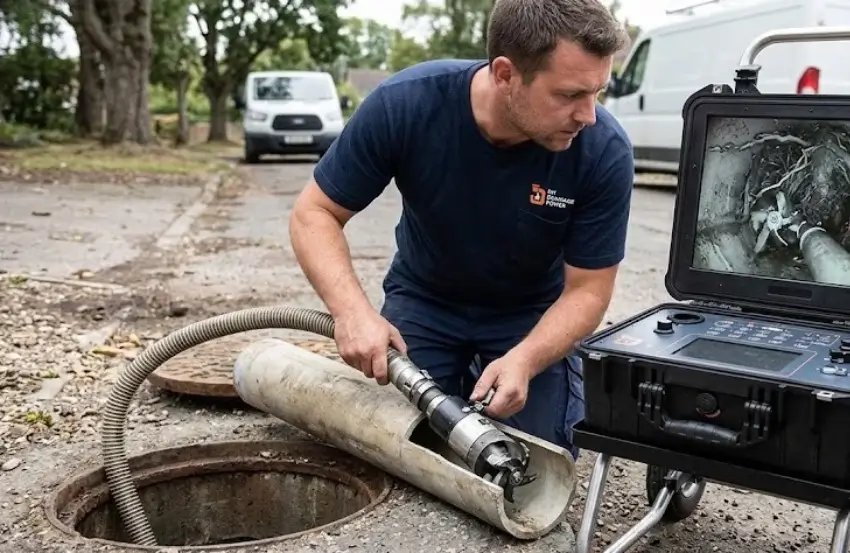
CCTV-controlled drain cutting is a specialist drainage technique in which camera footage helps an operator identify and monitor the removal of an obstruction inside a drainpipe.
CCTV stands for closed-circuit television. In drainage work, a waterproof camera is introduced into a pipe to show its internal condition. Depending on the system, the cutting attachment may be guided by an integrated camera or monitored using separate inspection equipment.
Unlike a basic drain clearance procedure, CCTV-guided cutting concentrates on specific obstructions that require mechanical removal.
The technique is relevant when a blockage is firmly attached to the pipe or cannot be cleared effectively through conventional cleaning.
What makes CCTV-guided cutting different?
The important difference is visibility. Without camera guidance, a drainage professional may know that water flow is restricted but lack a clear view of the exact cause. A CCTV inspection helps determine whether the problem involves roots, deposits, structural defects or another obstruction.
When cutting is appropriate, visual monitoring can help the operator work more precisely and assess the outcome. The Chartered Institute of Plumbing and Heating Engineering (CIPHE) provides drainage guidance covering drainage inspection and maintenance practices, including the use of CCTV equipment.
What Is CCTV-Controlled Drain Cutting Used For?
The technique is primarily used for removing suitable, persistent obstructions inside drainage pipes.
1. Cutting tree roots inside drains
Tree roots are a common cause of recurring drainage problems.
Roots can enter pipes through damaged joints, small cracks or other openings. Once inside, they may grow and trap waste, gradually reducing the available space for wastewater.
CCTV-guided cutting can help remove root material that obstructs the pipe.
However, cutting roots does not automatically repair the opening through which they entered. A separate assessment may be necessary to determine whether the pipe requires repair.
For more information about identifying underground drainage problems, read DH Drainage Power’s CCTV drain survey guide for London properties.
2. Removing stubborn internal obstructions
Some drain blockages contain compacted or hardened material that ordinary flushing cannot remove.
Depending on the obstruction and the pipe condition, controlled cutting may provide an alternative method of clearance.
Not every blockage requires cutting. Grease, soft debris and loose waste can often be addressed using other professional drain clearance methods.
The objective is to select a technique that removes the obstruction while limiting the risk of damage to the existing pipe.
3. Restoring flow through restricted pipes
A drain may still carry water even when part of its internal diameter is obstructed.
This partial restriction can become more noticeable during heavy use or periods of increased wastewater discharge.
Appropriate CCTV-guided cutting may remove the material responsible for narrowing the pipe, allowing a professional to assess whether adequate flow has been restored.
If the restriction is caused by a collapsed or severely displaced pipe, cutting alone is unlikely to provide a suitable repair.
4. Assisting selected drain maintenance and repair work
Some specialist drainage systems use mechanical cutting equipment as part of more complex repair processes.
For example, robotic cutting equipment may be used by suitably equipped contractors for particular lining or reinstatement tasks.
However, CCTV-controlled drain cutting and robotic drain cutting are not necessarily the same service. The equipment and intended operation can differ.
DH Drainage Power confirms CCTV-controlled cutting as a service, but the published information reviewed does not establish that it provides every type of robotic cutting or lining reinstatement. Such capabilities should be confirmed before booking.
How Does CCTV-Guided Drain Cutting Work?
The process normally begins with an investigation rather than immediate cutting.
Typical professional workflow
-
Inspect the drain: Camera footage identifies the suspected obstruction and visible pipe defects.
-
Assess suitability: The operator considers the pipe material, condition, access and appropriate clearance technique.
-
Position equipment: Suitable cutting equipment is introduced through an available access point.
-
Monitor cutting: Camera guidance is used to observe and control the removal of the obstruction.
-
Remove debris: The loosened material is cleared using an appropriate method.
-
Check the result: A follow-up inspection may establish whether the obstruction has been removed and whether pipe defects remain.
Why is the initial camera inspection important?
An inspection can identify problems that should not be approached with cutting equipment.
For example, extensive cracking, displaced joints or a partial collapse may make mechanical cutting unsuitable.
Camera footage can also reveal that the original blockage is only a symptom of a larger problem.
This is particularly relevant when a property has experienced repeated blockages despite previous clearance work.
Does CCTV-controlled cutting always avoid digging?
Many internal drainage operations can be completed through existing access points, but this depends on the location and condition of the drain.
Excavation or other repair methods may still be necessary if the pipe is collapsed, inaccessible or too badly damaged for internal work.
The purpose of camera-guided assessment is to help identify an appropriate method rather than assume every problem can be resolved without excavation.
CCTV Drain Cutting vs Drain Jetting: What Is the Difference?
Drain cutting and water jetting are different techniques, although they can sometimes complement each other.
Water jetting uses pressurised water to clean or remove suitable deposits and obstructions. Cutting uses mechanical action to remove material that requires a more targeted approach.
| Feature | CCTV-controlled cutting | Drain jetting |
|---|---|---|
| Main purpose | Targeted removal of suitable solid obstructions | Cleaning and flushing suitable deposits |
| Typical applications | Root intrusion and certain stubborn obstructions | Grease, sludge and general debris |
| Camera use | Used to guide or monitor the cutting operation | May be used before or after jetting |
| Best for | Selected obstructions requiring mechanical removal | Suitable accumulations removable with water |
| Limitations | Requires suitable pipe condition and access | May not remove every solid obstruction |
| Pipe repair included? | No, not inherently | No |
A drainage professional may recommend cleaning before cutting to improve visibility or access.
In other cases, cutting may be followed by suitable cleaning to remove the material left behind.
Neither technique should be treated as a universal solution. A heavily damaged pipe may require repair instead.
What Warning Signs Suggest Specialist Drain Cutting May Be Needed?
Symptoms alone cannot confirm that cutting is required. However, persistent drainage problems may justify further investigation.
Common warning signs include:
-
Drain blockages that return after previous clearance.
-
Toilets, baths or sinks draining unusually slowly.
-
Gurgling sounds coming from drainage pipes.
-
Unpleasant smells around external drains.
-
Wastewater backing up through connected fixtures.
-
Camera evidence of roots or other solid internal obstructions.
-
Repeated drainage issues affecting several fixtures.
Why do recurring blockages matter?
A blockage that repeatedly returns may indicate an unresolved underlying fault.
For example, clearing waste trapped around tree roots may restore temporary flow without removing the roots or repairing a damaged joint.
Similarly, a pipe that has become misshapen or displaced may continue collecting waste even after professional cleaning.
According to Croydon Council’s drain blockage guidance, recurring drainage problems may require further investigation to identify possible pipe defects or obstructions.
Can CCTV Drain Cutting Damage Pipes?
Any mechanical work inside a drain carries some risk, particularly where pipes are already weak or damaged.
CCTV guidance helps the operator observe the work, but it cannot guarantee that damage will not occur.
The level of risk depends on several factors.
Pipe age and material
Older drainage systems may contain clay pipes with joints that have deteriorated over time. Other drainage systems use plastic, concrete or different materials.
Each material has characteristics that affect whether mechanical cutting is appropriate.
Existing structural damage
Cracks, displaced joints and weakened pipe walls can increase the risk associated with internal cutting.
An initial inspection is therefore important before deciding whether the obstruction should be cut, cleaned or addressed through repairs.
Type and position of obstruction
An obstruction fixed firmly against the pipe wall may be more challenging to remove than loose material.
A professional must assess whether cutting can be carried out without creating an unacceptable risk to the drainage system.
For further information about how drainage defects are investigated, see the guide to blocked drain repairs in London.
What Happens When Tree Roots Are Cut but the Pipe Is Not Repaired?
Root cutting can remove an obstruction without eliminating the defect that allowed the roots to enter.
This distinction matters for long-term drainage maintenance.
Tree roots seek moisture and may enter drainage pipes through existing weaknesses. Once a route into the pipe remains available, further growth can occur.
A professional inspection may identify cracked joints or other damage requiring additional work.
The appropriate follow-up depends on the severity and location of the defect.
For example, some pipes may be suitable for an internal repair technique, while others may require excavation or replacement. These are general drainage repair options, not a claim that every technique is offered by DH Drainage Power.
Is CCTV-Controlled Drain Cutting Suitable for Residential and Commercial Properties?
CCTV-guided cutting can be relevant to both residential and commercial drainage systems, provided the pipe and obstruction are suitable.
Residential properties
Homeowners may encounter drainage restrictions in underground pipes connected to kitchens, bathrooms, toilets or external inspection chambers.
Older properties may have drainage systems with ageing joints, while gardens and neighbouring trees can create conditions where root ingress becomes possible.
For landlords and managing agents, recurring blockages should be investigated carefully because repeated temporary clearance may not address the cause.
Maintaining records of previous drainage work can help identify patterns.
Commercial properties
Businesses often need reliable drainage to maintain day-to-day operations.
Restaurants, offices, retail premises and other commercial buildings may experience disruption when wastewater cannot drain correctly.
Where camera investigations reveal a solid internal obstruction, specialist cutting may be considered as part of a drainage maintenance plan.
Commercial property managers should also consider access arrangements, operating hours and the consequences of taking affected drainage facilities temporarily out of service.
London and surrounding areas
London’s varied building stock includes older houses, flats, converted properties and commercial buildings, all with different drainage layouts.
Properties across Croydon, Wembley, Kingston upon Thames, Hounslow and nearby areas may have underground drains that cannot be assessed simply by looking at the affected sink or toilet.
A CCTV investigation helps distinguish between an isolated blockage and a more complex underground fault.
DH Drainage Power provides drainage services across London, Greater London and surrounding service areas.
What Can Property Owners Safely Do Before Calling a Drainage Specialist?
Property owners should not attempt internal drain cutting themselves.
Cutting equipment can damage pipes when used incorrectly, and underground drainage systems may present contamination and access hazards.
The UK Health and Safety Executive (HSE) provides confined space safety guidance explaining the serious hazards associated with entering confined spaces, including dangerous atmospheres and flooding.
Safer steps include:
-
Stop using affected toilets, sinks or appliances if wastewater is backing up.
-
Keep people and pets away from contaminated water.
-
Record when the problem began and which fixtures are affected.
-
Check previous drainage reports, if available.
-
Avoid mixing or repeatedly pouring chemical drain cleaners into the system.
-
Do not enter manholes, chambers or confined drainage spaces.
-
Arrange professional assistance if the blockage persists or wastewater overflows.
What should you tell a drainage professional?
Provide a clear description of the symptoms.
Explain whether the problem affects one fixture or several, whether previous clearance work has been carried out and whether the issue occurs after heavy use.
Mention any previous CCTV inspections or known pipe defects.
This information can help the specialist plan the investigation, although it cannot replace examination of the drainage system.
How Can You Reduce the Risk of Future Drain Blockages?
Preventative maintenance cannot eliminate every drainage fault, but sensible habits can reduce the accumulation of materials that contribute to blockages.
For homeowners, useful steps include keeping cooking fats out of sinks, avoiding the disposal of wipes through toilets and addressing slow drainage before it becomes severe.
Commercial property managers should ensure that staff understand appropriate waste disposal and that any drainage maintenance programme reflects the property’s usage.
Where tree roots or structural problems have previously been identified, periodic assessments may be appropriate depending on professional recommendations.
A simple maintenance checklist includes:
-
Dispose of fats, oils and grease through appropriate waste arrangements.
-
Keep wipes, sanitary products and other unsuitable materials out of toilets.
-
Monitor recurring odours, slow drainage and gurgling.
-
Keep accessible inspection points clear of stored items.
-
Retain drainage inspection reports for future reference.
-
Seek professional advice when blockages repeatedly affect the same drain.
The objective is not simply to clear a blockage but to understand why it developed and whether further maintenance or repairs are necessary.
When Should You Contact a Professional for CCTV Drain Cutting?
Professional investigation is particularly important when drain blockages persist despite suitable clearance work or CCTV footage identifies roots and other solid obstructions.
It is also advisable when several connected drainage fixtures are affected, wastewater repeatedly backs up or there is evidence of a damaged underground pipe.
DH Drainage Power lists professional drain inspections and clearance services for residential and commercial properties across London and surrounding areas.
A drainage assessment can help establish whether CCTV-controlled cutting is suitable or whether another clearance or repair method is more appropriate.
For urgent overflowing or blocked drains, DH Drainage Power offers 24/7 emergency drainage support.
Frequently Asked Questions About CCTV-Controlled Drain Cutting
1. What is the main purpose of CCTV-controlled drain cutting?
The main purpose is to remove suitable solid obstructions inside drainage pipes while using camera guidance to monitor the operation. It is particularly relevant where tree roots or stubborn internal material restrict water flow. The procedure is not appropriate for every blockage, and the condition of the pipe should be assessed before cutting equipment is used.
2. Is CCTV-guided drain cutting the same as a CCTV drain survey?
No. A CCTV drain survey is primarily used to inspect the inside of drainage pipes and identify faults. CCTV-guided cutting involves the physical removal of suitable obstructions while the work is monitored using camera equipment. A survey may be carried out before cutting to determine whether the procedure is necessary and appropriate.
3. Can CCTV-controlled drain cutting remove tree roots permanently?
Cutting can remove root material that is obstructing a drain, but it does not necessarily prevent new roots from entering. Where roots have entered through damaged joints or cracks, the underlying defect may need repair. A follow-up inspection can help determine whether further work is required to reduce the likelihood of recurring blockages.
4. Does CCTV drain cutting require excavation?
Not always. Some CCTV-guided cutting operations can be carried out through existing drainage access points. However, pipe condition, access limitations and the type of obstruction may make excavation or another repair method necessary. A professional inspection is needed before deciding whether the problem can be addressed internally without digging.
5. Can robotic drain cutting repair damaged pipes?
Robotic cutting and pipe repair are different operations. Certain specialist robotic systems can assist with selected drainage renovation tasks, but cutting alone does not restore a cracked, collapsed or leaking pipe. The repair method depends on the defect and pipe condition. Customers should confirm the specific equipment and repair capabilities offered by their drainage contractor.
6. How do I know whether my drain needs cutting or jetting?
Symptoms alone are usually insufficient to determine which technique is appropriate. Jetting may remove suitable grease, sludge and loose debris, while cutting may be considered for harder or more firmly attached obstructions. CCTV inspection helps identify the restriction and assess the pipe condition so a drainage professional can recommend a suitable method.
7. Is CCTV-controlled drain cutting available for commercial properties in London?
CCTV-controlled cutting can be relevant to appropriate commercial drainage systems. DH Drainage Power lists this technique among its drainage services and works with residential and commercial customers across London and surrounding areas. The suitability of a particular drain depends on inspection findings, access and equipment requirements. Commercial property managers can contact the company to discuss their drainage problems.
Conclusion: Understanding When CCTV Drain Cutting Is Needed
CCTV-controlled drain cutting is a specialist technique for removing selected obstructions inside drainage pipes. It can be useful where tree roots or stubborn internal material restrict water flow, but careful inspection is necessary to determine whether cutting is appropriate.
The most effective approach depends on the actual problem. Some drains need cleaning, others require targeted cutting, and damaged pipes may need repair.
For drainage problems across London and surrounding areas, DH Drainage Power provides CCTV inspections, drain clearance, tree root removal, drainage repairs and CCTV-controlled drain cutting.
Need Help With a Persistent Drain Blockage?
DH Drainage Power provides CCTV-controlled drain cutting, drain inspections and drain clearance across London and surrounding areas.
Call +447897041092 for drainage assistance. Our emergency drainage services are available 24/7.
Contact DH Drainage Power to discuss your drainage problem.