No-dig drain repair is usually the right first option when a drain or sewer is structurally defective but still suitable for trenchless rehabilitation. In the UK, official water-industry guidance says gravity sewer rehabilitation should use non-dig or low-dig methods where possible. Therefore, this makes no-dig repair more than a convenient shortcut.
TL;DR: Summary
- No-dig drain repair is a standards-based trenchless method, usually using CIPP lining or localised CIPP repair, and it is often the best first option when the pipe can be rehabilitated without excavation.
- Water UK guidance says gravity sewer rehabilitation should use non-dig or low-dig methods where possible, and cured-in-place pipe systems are a principal method for sealing defective sewers.
- In practice, the right choice depends on pipe condition, location, diameter, bends, deformation, root ingress, collapsed sections, and whether the defect is local or spread along the line.
- CIPP lining in the UK is tied to formal standards, including BS EN ISO 11296-4 and Water Industry Specifications for installation and leak-tightness testing.
- In England and Wales, private drains within your property boundary are usually the homeowner or occupier’s responsibility, while lateral drains and public sewers are usually the water company’s responsibility.
- If CCTV shows a collapse, severe deformation, or a pipe that has lost too much bore, excavation may still be necessary even if no-dig repair was the preferred starting point.
That means the first question is not simply “is no-dig better?”, but “is this specific defect suitable for no-dig repair, and who is responsible for it?”. A proper answer normally starts with CCTV evidence, a clear defect map, and a decision between patch repair, full lining, local excavation, or replacement.
What is no-dig drain repair?
No-dig drain repair is a trenchless method that fixes defective pipes using CIPP lining, CIPR patches, or robotic repairs without full excavation. In UK drainage work, it is commonly used on gravity drains and sewers where the host pipe still has enough shape and continuity to be rehabilitated.
The phrase covers a group of rehabilitation methods rather than one product. The most common is cured-in-place pipe lining, often shortened to CIPP, where a resin-impregnated liner is inserted and cured inside the existing pipe. Localised repairs may use CIPR, which focuses on a specific defective section rather than the whole run.
This matters because many people assume no-dig means a temporary fix. That is a common misconception. In reality, UK water-industry specifications treat these systems as formal rehabilitation methods, not improvised patch-ups.
When is no-dig drain repair suitable?
No-dig drain repair is suitable when CCTV shows cracks, leaking joints, root ingress, minor displacement, or local defects. The pipe must still allow liner installation. CIPP and localised repair work best when the drain has not fully collapsed. Additionally, the access should be practical from chambers or rodding points.
A suitable drain usually has one or more structural problems, but not total failure. If the pipe still holds a continuous path, a liner can often restore integrity and improve leak-tightness. Water UK guidance on sewer rehabilitation states that non-dig or low-dig methods should be used where possible for gravity sewers. This reflects current best practice.
Where no-dig becomes less suitable is where the defect has gone too far. A fully collapsed section, severe ovality, or major loss of internal diameter can stop a liner from seating correctly. If the camera survey shows that the host pipe no longer provides a workable shape, excavation moves from fallback option to sensible option.
“DH Drainage Power provides 24/7 emergency drain clearance, repairs, and CCTV inspections across London and surrounding areas.”
What are the main no-dig drain repair methods?
The main no-dig drain repair methods are CIPP lining, localised CIPP patch repair, lateral connection repair, joint sealing, robotic repair, and stabilisation. Water UK guidance and WIS documents treat these as distinct methods, each suited to a different defect pattern.
If the problem is spread along a run, full lining is often the better fit. If the damage is concentrated at one joint or crack, a local repair may be enough. That distinction affects cost, installation time, and how much internal diameter is reduced.
- CIPP full-length lining: A liner is installed through a longer pipe run, often manhole-to-manhole, to create a new pipe within the old one.
- Localised CIPP repair or CIPR: A short patch repairs one defect or a small defective zone without lining the whole drain.
- Lateral connection repair: Used where the issue sits around a branch connection between a property drain and the main run.
- Joint sealing: Targets leaking joints rather than broader structural deterioration.
- Robotic repair and stabilisation: Used for selected internal defects, cutting, sealing, or preparing the pipe before another repair stage.
A useful rule is simple. If defects are isolated, patching may be enough. If defects repeat across several metres, full lining often gives a cleaner long-term result.
How is a no-dig drain repair assessed step by step?
A no-dig drain repair is assessed through CCTV evidence, defect grading, and access checks before any liner is chosen. In practice, the process should identify both the defect type and whether the existing pipe can physically accept a trenchless repair.
First, the drain is cleaned so the camera can see the pipe wall properly. A survey done through standing debris or heavy grease can hide cracks, open joints, and displaced sections. This leads to the wrong repair choice.
Next, the survey identifies the exact defect pattern. Is it root ingress at one joint, multiple fractures along the run, or a section that has deformed after ground movement? The answer decides whether you need a patch, a full liner, or excavation.
Then access and dimensions are checked. Pipe diameter, bends, entry points, and connection details all matter. A repair that works on a straight 100 mm domestic drain may not be practical on a more awkward run with tight changes of direction.
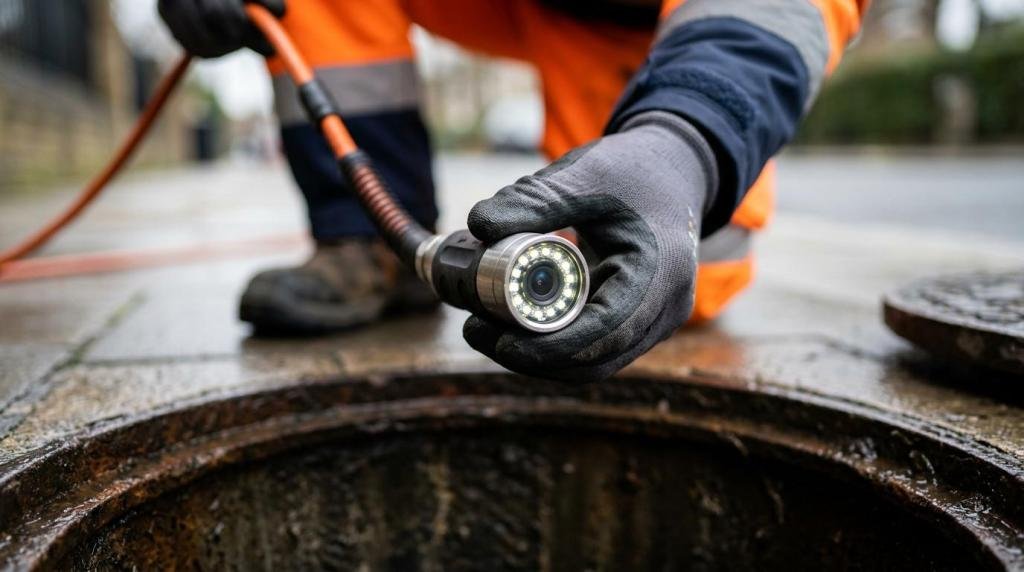
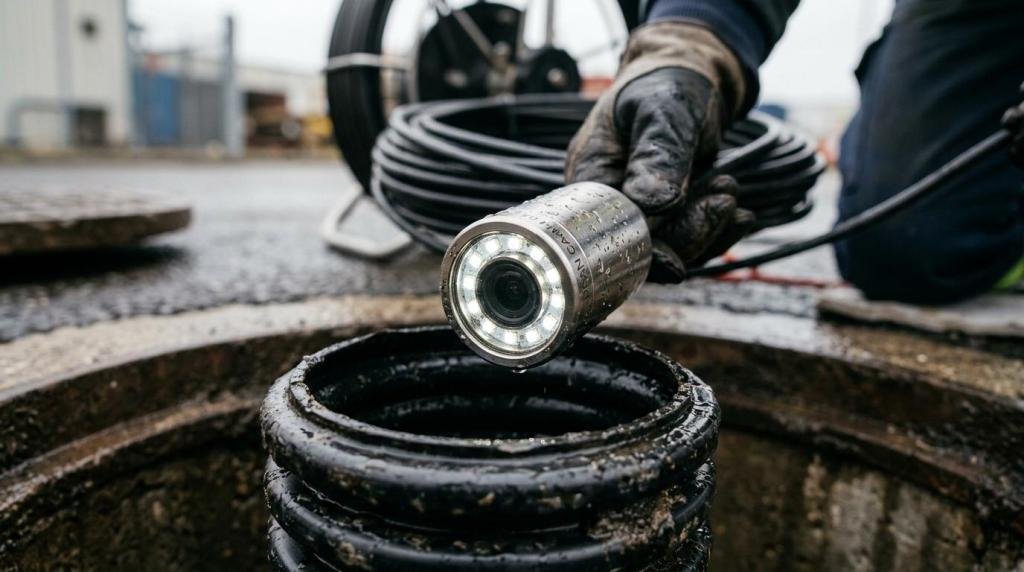
“DH Drainage Power uses specialist CCTV diagnostic technology to diagnose drain faults quickly and clearly.”
How does CIPP lining get installed step by step?
CIPP lining is installed by cleaning the pipe, measuring the run, inserting the resin liner, curing it, and reopening connections. Standards like BS EN ISO 11296-4 sit behind this work. Consequently, it is not simply a matter of pushing material into a drain.
First, the line is cleared and prepared. That can include root cutting, descaling, and removal of grease or debris. Preparation is not optional. If contamination stays on the pipe wall, the liner may not bond or sit correctly.
Second, the liner is inserted and positioned. Depending on the system, installation may use inversion or another insertion method. The liner is designed to match the pipe size and length. Moreover, resin is selected for the application and curing method.
Third, the liner is cured and checked. Once cured, branch connections may need reopening with robotic cutting equipment. A post-installation CCTV survey confirms the shape, finish, and continuity of the lining.
This is also where standards matter. Water Industry Specification WIS 4-34-04 links CIPP renovation to BS EN ISO 11296-4, and WIS 4-34-07 covers leak-tightness testing of CIPP lining systems for gravity sewer rehabilitation. That formal framework is one reason no-dig repair is widely accepted for defective sewers.
“DH Drainage Power handles drain repairs, CCTV surveys, and emergency unblocking for residential and commercial properties with clear, honest pricing.”
How does no-dig drain repair compare with excavation?
No-dig drain repair usually means less disruption, faster completion, and less reinstatement than excavation. Meanwhile, excavation remains better for collapses and badly deformed pipes. The trade-off is simple: trenchless repair preserves surfaces, but only when the host pipe is still viable.
If your drain runs under a driveway, patio, extension, or landscaped garden, no-dig repair can avoid major reinstatement costs. That is often the real financial advantage. People sometimes compare repair prices alone. However, they often forget to include digging, waste removal, re-laying paving, and time lost to a larger site job.
Excavation, though, still has clear strengths. It gives direct access, allows full replacement, and works when the original pipe has lost structural form. If the CCTV shows a crushed section or a complete break with soil ingress, a liner cannot create a stable path out of nothing.
So the comparison is not old versus modern. It is suitability versus unsuitability.
When is patch lining better than full-length lining?
Patch lining is better than full-length lining when the defect is local, the rest of the pipe is sound, and CCTV shows no widespread deterioration. Full-length CIPP is usually better when cracks, open joints, or infiltration appear across multiple sections of the same run.
A localised repair is often the most efficient answer to a single failed joint or a short root-damaged area. Water Industry Specification WIS 4-34-06 covers localised cured-in-place systems for structural repairs, which shows that targeted repair can be a proper structural solution where the defect pattern supports it.
Full lining earns its place when the pipe has repeated defects or is ageing along most of its length. In that case, multiple patches can become false economy. If you already know that several points are failing, one continuous liner may provide a more predictable outcome.
A common mistake is asking for a patch because it sounds cheaper. If the pipe has five weak joints in ten metres, a patch treats one symptom, not the problem.
Who is responsible for a private drain, lateral drain, or public sewer?
In England and Wales, private drains within your property boundary are usually the homeowner or occupier’s responsibility, while lateral drains and public sewers are usually the water company’s responsibility. Local authority guidance and water-company practice broadly follow that division.
For properties already connected to the public sewer system, the pipe serving only your property and lying within your boundary is usually classed as a private drain. If it blocks or becomes structurally defective, the occupier, owner, or freeholder normally arranges repair.
Once the pipe leaves your boundary but still carries flow from your property to the public sewer, it is often a lateral drain. In many cases, that section, along with public sewers, sits with the water company rather than the homeowner.
If there are several homes using a shared private sewer, costs can be shared between householders. The exact boundary still needs checking, because shared drainage layouts are not always obvious from the surface.
A pro tip here is simple: confirm pipe ownership before authorising repair works. Many avoidable call-out costs start with repairing the wrong section or contacting the wrong party first.
How do you choose the right no-dig drain repair method step by step?
The right no-dig repair method is chosen by matching the defect map, pipe condition, and ownership status to the least disruptive suitable option. CCTV findings, Water UK method categories, and site access all shape that decision.
Start with defect scope. If the issue is isolated, ask whether a localised CIPP repair can solve it. If defects repeat along the run, ask whether full-length lining would prevent repeat failures.
Then check structural suitability. If the host pipe has enough form to support rehabilitation, no-dig stays on the table. However, if deformation is severe or a section has collapsed, excavation should be priced alongside any trenchless option.
Finally, confirm responsibility and practical constraints. A repair on a private drain under your kitchen extension is one decision. A defect on a lateral drain outside the boundary is another, because the water company may need to take over.
The best choice is rarely the cheapest line item on a quote. It is the method that actually matches the defect and avoids paying twice.
What risks or limits should you know before approving no-dig work?
No-dig drain repair has limits, and the main risks come from poor diagnosis, poor preparation, or choosing lining where replacement was needed. CIPP and patch repairs are effective. Yet, they are not suitable for every failure mode.
Before approving work, look at these trade-offs:
- Host pipe condition: If the original pipe is too distorted or collapsed, trenchless repair may fail or deliver a poor fit.
- Internal diameter loss: Liners reduce bore slightly, which is usually acceptable in domestic drainage but still needs checking on already restricted lines.
- Connection management: Branches may need reopening accurately after lining, especially on more complex runs.
- Future access: A good post-installation CCTV record helps if a later blockage or sale survey raises questions.
Another misconception is that no-dig always means no mess. Access points still need setting up, cleaning is still required, and resin systems need controlled installation. It is less disruptive than excavation, not disruption-free.
What should you ask a drainage contractor before work starts?
You should ask for the CCTV evidence, the defect location, the proposed repair type, and the reason excavation is or is not needed. A competent contractor should explain whether the recommendation is CIPP lining, localised repair, or digging, and why.
Clear questions help you compare quotations properly:
- What did the CCTV survey show?: Ask for the exact defect type, pipe material, diameter, and length affected.
- Why is this method suitable?: The answer should link the repair choice to the defect pattern, not just price.
- Is this my responsibility or the water company’s?: Ownership should be checked before private works start.
- What preparation is included?: Cleaning, root cutting, reopening junctions, and a post-repair CCTV check should be clear.
- Which standards or specifications are relevant?: For CIPP work, references to recognised UK practice and standards are a good sign.
If a contractor cannot explain the repair in plain terms, that is a warning sign. Good drainage work is technical, but the recommendation itself should still be easy to follow.