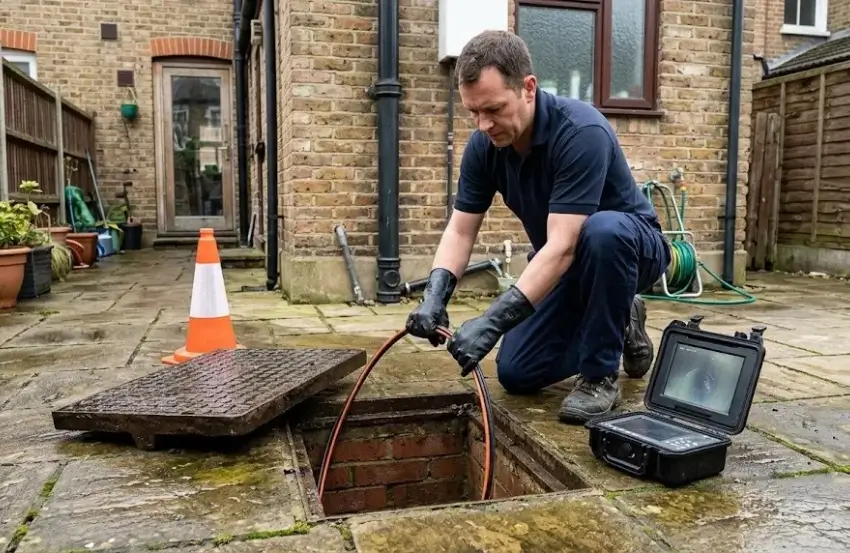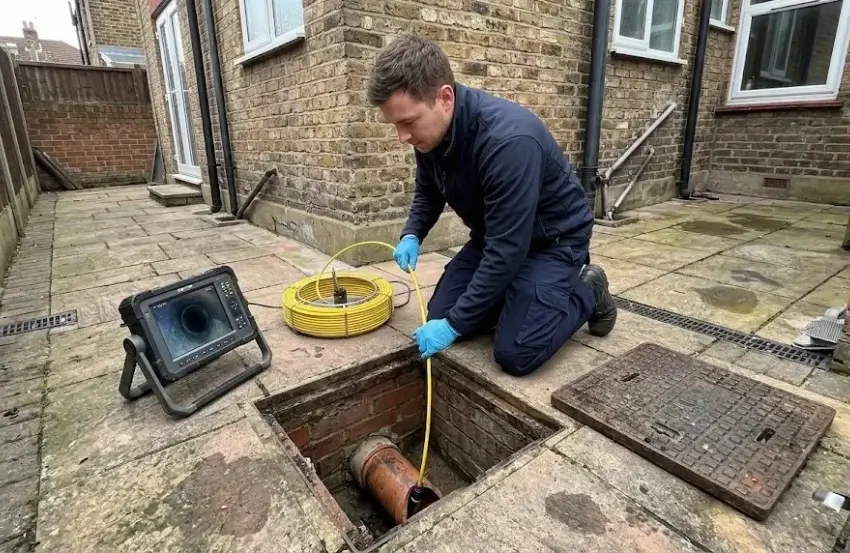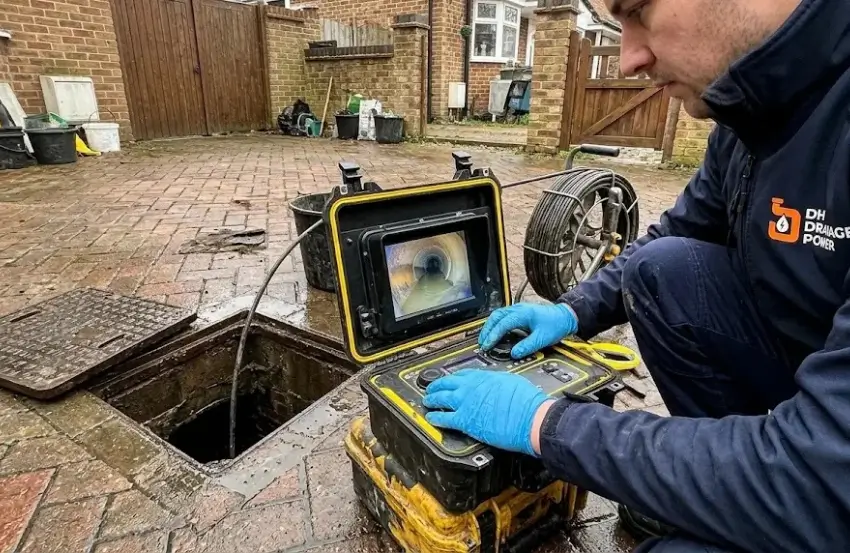
Yes, plaster and cement washout can block drains when construction residue enters drainage pipes and gradually forms deposits or hardens into a solid obstruction. Fine particles may initially travel with wastewater, but they can settle around bends, joints and existing debris. As cement sets or plaster residue builds up, the available space inside the pipe can become restricted, leading to slow drainage, recurring blockages or wastewater backing up into the property.
The problem often begins during building work, kitchen renovations, bathroom refurbishments or external paving projects. Washing buckets, plastering tools or cement-covered equipment into sinks, gullies or outside drains can introduce materials that ordinary drainage systems are not designed to carry.
DH Drainage Power helps homeowners, landlords and businesses across London and Greater London investigate blocked drains, including problems associated with construction debris.
When cement blocking drains is suspected, stop introducing additional waste into the affected pipe and avoid attempting to dissolve hardened material with household chemicals. A professional inspection can help determine where the obstruction is located, whether the pipe has suffered damage and which clearance method is suitable.
Understanding how construction washout affects drainage systems is particularly important before, during and after renovation work.
How Do Cement and Plaster Washout Enter Drainage Pipes?
Construction work can create several types of waste that should be kept separate from a property’s drainage system. Cement, mortar, plaster, concrete slurry and fine building dust may all enter drains through improper cleaning or accidental run-off.
Although these materials are common on building sites, drainage pipes are designed to carry appropriate wastewater, not substantial quantities of construction solids.
Cement and mortar washout
Cement washout is wastewater containing cement particles and other residue produced when tools, equipment or containers are rinsed.
For example, a builder might wash a cement-covered bucket near an external gully. The mixture can travel into the drain while still wet, leaving solid particles inside the pipe.
Once cementitious material begins to set, removal can become significantly more difficult.
Mortar and concrete can create similar problems because their solid constituents may accumulate within the drainage network.
Plaster residue from interior renovations
Plaster washout commonly occurs during wall repairs, ceiling work and property refurbishment.
Water used to clean plastering tools may contain gypsum-based particles or other ingredients, depending on the plaster product.
These particles can settle inside waste pipes and traps. Certain plaster products also set when mixed with water, which increases the risk of stubborn deposits.
Repeated disposal of plaster-contaminated water can therefore create an obstruction even when no single large quantity is poured into the drain.
Building waste entering external gullies
Outside drains are particularly vulnerable during driveway installations, paving, garden renovations and building extensions.
Construction materials may enter a surface water gully when:
-
Cement mixing takes place close to an uncovered drain.
-
Wet mortar or concrete is washed off tools.
-
Rainwater carries loose building material towards a gully.
-
Plastering buckets are emptied into external drainage points.
-
Building debris is accidentally swept into a drainage opening.
External gullies should be protected during construction work to prevent debris and contaminated water entering the system.
The UK government’s pollution prevention guidance explains why contaminated water must be managed appropriately and why correct drain identification matters.
Why Does Cement Harden and Cause Drain Blockages?
Cement reacts chemically with water through a process called hydration. This reaction gradually produces a solid, hardened material.
Inside drainage pipes, the process can create a persistent obstruction, particularly where cement residue remains undisturbed.
Cement can accumulate around bends and joints
A drainage pipe may contain bends, junctions and changes in gradient. These areas can collect heavier particles when wastewater flow is insufficient to carry them away.
Cement particles may settle on existing deposits, creating a surface on which additional material accumulates.
Over time, the pipe’s internal opening may become narrower.
Existing drainage problems increase the risk
A pipe that already contains grease, silt, roots or displaced joints may trap construction residue more easily.
For example, a small amount of cement slurry entering a drain with an existing partial blockage may contribute to a much more serious obstruction.
This is why construction debris should not be treated as an isolated problem without considering the condition of the surrounding pipework.
Can hardened cement completely block a drain?
Yes. Sufficient hardened material can substantially restrict or completely obstruct wastewater flow.
A partial obstruction may initially allow water to pass through. However, solid waste and other debris can accumulate against the restriction until drainage becomes ineffective.
Hardened cement does not behave like ordinary grease or loose organic waste. Repeated flushing may be ineffective and could contribute to an overflow when the pipe is already severely restricted.
What Are the Warning Signs of Cement Blocking Drains?
Construction-related blockages often become noticeable shortly after renovation work, although some develop gradually.
The timing of symptoms can provide a useful clue, but it cannot confirm the exact material inside the drain.
Common warning signs
-
Slow-draining sinks: Water takes longer than usual to disappear after building work.
-
Gurgling drainage pipes: Air movement becomes restricted as wastewater passes through a narrowed section.
-
Water backing up: Wastewater returns through a sink, shower or other connected fixture.
-
Repeated blockages: The drain appears to clear temporarily but becomes obstructed again.
-
Standing water in external gullies: Rainwater or wastewater accumulates near the drainage opening.
-
Several fixtures affected: A restriction may be located further along a shared drainage run.
A CCTV inspection can help distinguish solid construction deposits from other causes, including displaced pipe joints, grease accumulation or structural damage.
Does a blocked drain after renovation always contain cement?
No. Building activity may introduce several different materials into a drainage system.
Broken tile fragments, sand, plaster, dust, sealant residue and loose rubble may contribute to a blockage.
Renovation work may also expose an existing drainage problem that was not previously obvious.
A correct diagnosis matters because the removal method for loose debris may differ considerably from the approach required for hardened cement attached to a pipe wall.
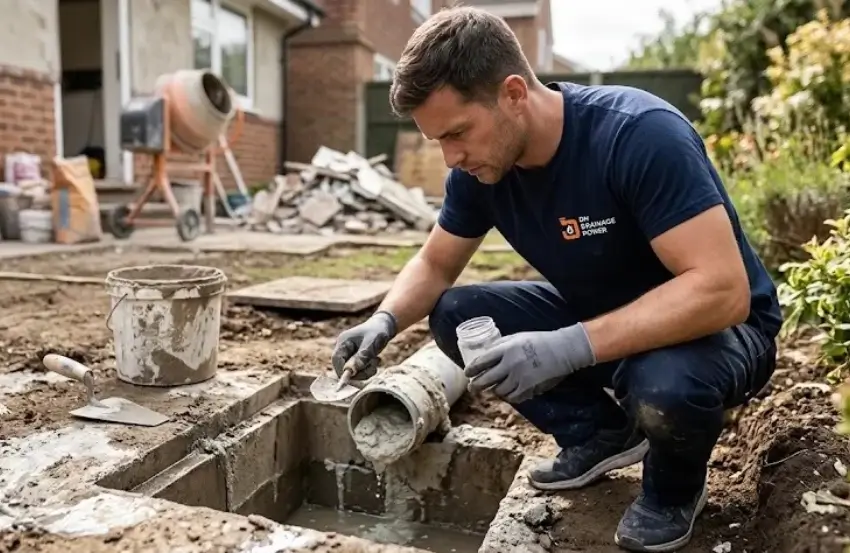
Cement, Plaster and Other Construction Waste: How Do They Affect Drains?
Different materials can behave differently after entering drainage pipes.
| Construction material | Possible effect inside drains | Appropriate response |
|---|---|---|
| Wet cement slurry | Particles may settle and harden | Prevent further discharge and arrange assessment |
| Hardened cement | Creates a firm obstruction that restricts flow | Professional inspection and suitable clearance |
| Wet plaster residue | May settle, accumulate or set | Avoid further disposal into drains |
| Sand and building dust | Can settle in traps, gullies and low-flow areas | Investigate significant accumulation |
| Tile fragments and rubble | May lodge at bends or damaged joints | Professional removal where inaccessible |
| Mortar residue | Can leave persistent cementitious deposits | Assess whether clearance or repairs are needed |
The important distinction is whether the material remains loose, has accumulated into a deposit or has hardened against the pipe.
This affects the likelihood of successful clearance and the risk of damaging the existing drainage system.
How Can Hardened Cement Be Removed From Drain Pipes?
Removing cement from drains requires an assessment of the obstruction’s location, hardness, extent and the condition of the pipe.
There is no single method suitable for every drainage system.
1. Inspecting the affected drainage line
A professional may begin by examining accessible drainage points and checking the symptoms reported by the property owner.
Where appropriate, a CCTV drain survey can provide a view of the pipe interior.
A camera inspection may help identify whether the obstruction is solid construction material, loose debris or a structural defect.
It can also reveal visible cracks or displaced joints that could make mechanical clearance more difficult.
Read more about professional drain inspection in London.
2. Removing loose construction debris
Loose material may sometimes be removed through suitable professional drain clearance techniques.
The appropriate method depends on the amount of debris, the accessibility of the pipe and the risk of pushing material further into the drainage system.
Professional water jetting can be useful for certain types of debris, but it is not automatically suitable for a drain containing substantial hardened cement.
An inspection helps establish whether the obstruction is likely to respond to cleaning.
3. Assessing hardened deposits
Where cement has formed a solid obstruction, specialist mechanical clearance may be considered.
The drainage professional must assess whether the material can be removed without creating an unacceptable risk to the pipe.
DH Drainage Power lists CCTV-controlled drain cutting among its available services. However, a particular cement obstruction should not be assumed suitable for cutting without checking the pipe condition and equipment requirements.
The article what CCTV-controlled drain cutting is used for explains this technique in more detail.
4. Investigating damaged pipework
Some solid obstructions may be associated with cracked, displaced or otherwise damaged drainage pipes.
Where significant damage is present, clearance alone may not resolve the problem.
A professional assessment may identify the need for targeted drainage repairs rather than repeated attempts to force material through the pipe.
DH Drainage Power offers drain repair and fault-finding services in London for residential and commercial properties.
Can high-pressure water jetting remove hardened cement?
Not reliably in every situation.
Water jetting can remove suitable loose debris and some deposits, but hardened cement may resist ordinary cleaning pressures.
Attempting to increase pressure without considering the pipe condition can create risks, especially where drainage systems are old, cracked or structurally weakened.
A professional should select the technique based on the obstruction and the pipe, rather than automatically treating every construction blockage with high-pressure water.
What Should You Do When Cement Enters a Drain?
Acting promptly can help limit additional material entering the system and reduce the risk of a more serious drainage problem.
The safest immediate steps are straightforward.
-
Stop discharging cement-contaminated water. Do not rinse additional tools, buckets or construction residue into the affected drain.
-
Avoid unnecessary water use. Where drainage is restricted, further wastewater can increase the risk of backing up.
-
Keep the affected area clear. Prevent additional construction debris entering nearby gullies or drainage openings.
-
Record what happened. Note which materials entered the drain, approximately when it occurred and which fixtures are affected.
-
Inform the responsible person. In rental or shared premises, notify the landlord, managing agent or site manager where appropriate.
-
Arrange professional advice. Seek drainage assistance when flow is restricted, backing up or suspected to contain hardened material.
These steps do not require dismantling underground drainage systems or handling hazardous cleaning chemicals.
Why should you avoid chemical drain cleaners?
Cement is not the same as the organic waste commonly responsible for household sink blockages.
Household drain-cleaning chemicals are not a dependable solution for hardened cement. They may expose occupants and drainage professionals to hazardous substances without removing the obstruction.
Do not mix chemical drain cleaners or pour acids into drains in an attempt to dissolve construction material.
Such actions can create serious safety risks and may damage pipework.
Should you use a drain rod?
Drain rods are not suitable for every obstruction.
Using force against a hardened deposit may damage a weakened pipe or cause equipment to become stuck.
Where the obstruction’s position and the pipe’s condition are unknown, professional inspection is a safer starting point than aggressive mechanical attempts.
Can Plaster and Cement Washout Damage Drainage Pipes?
Construction waste can cause problems beyond the immediate blockage.
Restricted wastewater flow
Solid deposits reduce the amount of space available for water to travel through the pipe.
This may cause wastewater to move slowly or back up into connected fixtures.
Additional pressure and overflows
When a drain becomes obstructed, wastewater can accumulate upstream of the blockage.
This increases the risk of overflowing gullies, toilets or other connected drainage points.
The resulting wastewater may damage floors, fixtures or surrounding surfaces.
Hidden pipe defects
Hardened material can make existing drainage faults more difficult to identify.
For example, a pipe with a displaced joint may collect construction residue, leaving the underlying structural problem unresolved after the obstruction is removed.
A CCTV investigation can help establish whether a pipe requires further attention.
Environmental contamination
Cement-contaminated water can also create environmental problems, particularly when it enters a surface water drain that discharges into the environment.
Cement washout can be highly alkaline. The Environment Agency publishes specific guidance for managing water containing concrete at construction sites.
Its guidance does not provide general permission to discharge cement-contaminated water into drains.
How Can Builders and Homeowners Prevent Cement Washout Entering Drains?
Prevention is particularly important during refurbishments, extensions, kitchen installations and outdoor construction work.
Controlling waste at the source is generally preferable to dealing with hardened material inside underground pipes.
Protect drainage openings before work begins
Identify nearby sinks, gullies, inspection chambers and surface water drainage points.
Use suitable temporary protection where necessary to prevent construction debris entering these openings.
Any protective covering should be managed carefully to avoid causing flooding or obstructing drainage during rainfall.
Establish a designated equipment-cleaning area
Builders should plan how tools, buckets and mixing equipment will be cleaned before construction begins.
Cleaning arrangements should prevent contaminated washwater from reaching drains, soil or watercourses.
Collected washout must be handled and disposed of using an appropriate method for the material and site conditions.
The Environment Agency’s concrete washout water guidance explains relevant controls for certain construction-site activities.
Remove solid debris before washing equipment
Dry or removable waste should be collected separately rather than deliberately washed into drainage systems.
The disposal arrangements must reflect the particular waste material, including whether it contains ingredients requiring special handling.
Do not assume that allowing contaminated water to settle makes the remaining liquid automatically safe to discharge.
Brief everyone working on the property
Building projects can involve several tradespeople working at different times.
A simple site rule helps prevent accidental contamination:
-
Do not empty plastering buckets into sinks or toilets.
-
Do not wash mortar or cement into outside gullies.
-
Keep drain covers and access points protected from debris.
-
Collect building waste using suitable containers.
-
Report accidental discharge promptly.
-
Check that temporary drain protection has been removed safely when work finishes.
These precautions are relevant to both small domestic renovations and larger commercial projects.
Who Is Responsible for a Drain Blocked During Building Work?
Responsibility depends on the location of the affected drain, the arrangements for the building project and how the blockage occurred.
A homeowner who arranged refurbishment work may need to discuss suspected construction contamination with the contractor.
For rental properties, landlords and tenants should review their respective obligations and report the problem promptly.
In commercial premises, responsibilities may involve the property owner, occupier, facilities manager or construction contractor.
Where several properties share a drainage system, it may be necessary to determine whether the obstruction is within private drainage, a shared private drain or a public sewer.
Why does the location of the blockage matter?
The point at which wastewater stops flowing does not always reveal where the obstruction is located.
For example, an affected sink may connect to an underground pipe serving several fixtures.
A blockage farther downstream can therefore produce symptoms in multiple rooms.
Drainage investigation can help establish the location of the restriction before decisions are made about access, repair work or responsibility.
The GOV.UK guidance on identifying and using drains correctly also explains the importance of understanding which drainage systems carry wastewater and which discharge surface water.
Why Are Construction-Related Drain Blockages Relevant to London Properties?
London contains a wide range of residential and commercial buildings, including terraced houses, converted flats, apartment blocks, offices and retail premises.
Different properties may have significantly different drainage layouts.
Homes and flats
In residential properties, renovation waste may enter kitchen sink outlets, bathroom drainage or exterior gullies.
Shared drainage arrangements can make a blockage more complicated because several occupants may be affected by one restricted pipe.
Where a flat forms part of a managed building, access to communal drainage may require authorisation.
Landlords and managing agents
Landlords and property managers should record drainage complaints that arise following refurbishment work.
Useful information includes the renovation dates, the contractor involved, the affected fixtures and whether other occupants have reported similar symptoms.
A documented inspection may help distinguish a construction-related obstruction from an unrelated drainage defect.
Commercial properties
Restaurants, offices, retail units and other commercial premises may experience operational disruption when drainage facilities cannot be used.
During commercial refurbishment, contractors and facilities managers should agree on suitable procedures for containing construction washout.
This helps reduce the risk of blockages affecting staff facilities, customer areas or shared building drainage.
DH Drainage Power provides drainage assistance across London, Greater London and surrounding areas, including Croydon, Wembley, Kingston upon Thames, Hounslow and Watford.
When Should You Contact a Professional Drainage Specialist?
Professional assistance is appropriate when construction material is suspected inside a drain and there is evidence of restricted flow, repeated blockages or wastewater backing up.
A professional inspection is particularly important when the obstruction may have hardened or when several drainage fixtures are affected.
Consider arranging professional assessment when:
-
A drain stops flowing after cement or plastering work.
-
Repeated attempts at ordinary cleaning have not restored normal flow.
-
Wastewater backs up into the property.
-
An external gully overflows after construction activity.
-
Solid material is visible within an accessible drainage point.
-
A shared drain appears to affect more than one property.
-
There are concerns about damaged underground pipework.
DH Drainage Power provides drain clearance, CCTV inspections, fault finding and drainage repairs across London and surrounding service areas.
For urgent problems, the company offers emergency drainage support, subject to attendance arrangements and site conditions.
Frequently Asked Questions About Cement Blocking Drains
1. Can a small amount of cement washout block a drain?
Yes, even a relatively small quantity of cement washout can contribute to a blockage, especially where a pipe already contains grease, silt or other debris. The risk depends on the amount discharged, the pipe diameter, water flow and existing drainage condition. Repeated small discharges can also create deposits, so cement-contaminated water should never be deliberately washed into drains.
2. How long does cement take to harden inside drain pipes?
The setting time varies depending on the cement product, mixture, temperature and surrounding conditions. Some cementitious materials begin setting within hours, although strength development continues afterwards. No reliable household waiting period exists after which you can safely flush away the material. You should promptly assess suspected cement contamination rather than leave it until a complete blockage develops.
3. Can plaster washout block a kitchen sink?
Yes. Plaster residue can collect inside a sink trap or farther along a waste pipe. Some plaster products set after mixing with water, creating a more persistent obstruction. Repeatedly washing plastering tools in a kitchen sink can increase the risk. Collect plaster waste separately and avoid introducing additional material into the affected drainage system.
4. Will boiling water or vinegar remove hardened cement?
Boiling water and vinegar are not reliable methods for removing hardened cement from drainage pipes. Hot water can also pose risks to some plumbing materials and fixtures, while attempting chemical dissolution may create additional hazards. Where hardened construction material is suspected, a professional inspection is more appropriate than experimenting with household chemicals.
5. Can a CCTV drain survey identify cement inside a pipe?
A CCTV drain survey can reveal visible obstructions, hardened deposits and changes in the pipe’s internal condition. However, camera footage may not always establish the exact chemical composition of a deposit. A professional can consider the appearance of the obstruction alongside the property’s recent construction history to determine the most appropriate next steps.
6. Does hardened cement always require drain excavation?
No. Some obstructions may be accessible using suitable internal drainage equipment. However, excavation may be necessary where the pipe has collapsed, the obstruction cannot be safely removed internally or existing access is inadequate. The decision depends on the pipe’s condition, the location of the material and the risks associated with clearance.
7. Can DH Drainage Power help with cement-related drain blockages in London?
DH Drainage Power provides drainage inspections, blocked drain clearance, CCTV-controlled cutting and drainage repairs for residential and commercial properties across London and surrounding areas. Its website also lists concrete, cement and builders’ rubble removal. The appropriate treatment depends on the particular obstruction and pipe condition, so contact the team to discuss the problem before assuming any specific removal method will be suitable.
Conclusion: Prevent Cement and Plaster From Entering Drains
Plaster and cement washout can cause serious drainage restrictions when construction particles accumulate or harden inside pipes. The most effective prevention is to keep building waste and contaminated washwater out of sinks, toilets, external gullies and underground drains.
Where a blockage has already developed, avoid aggressive DIY removal or chemical treatments. A suitable inspection can establish the likely cause and help determine whether cleaning, specialist clearance or drainage repairs are necessary.
Need Help With Cement Blocking Drains in London?
DH Drainage Power provides professional drainage inspections, drain clearance and repair services for homes and businesses across London, Greater London and surrounding areas.
Our emergency drainage support is available 6am to 10pm, 7 days a week.
Call: 07897041092
Website: https://dhdrainagepower.co.uk/
Contact: Request drainage assistance
Contact DH Drainage Power to explain your drainage problem and discuss the appropriate next steps.