A drainage survey report can contain unfamiliar terms such as vitrified clay, uPVC, cast iron or pitch fibre. These terms identify the drain pipe materials found within a property’s drainage system and help explain how the pipes may respond to wear, ground movement, blockages and structural damage.
Understanding these materials is important because each has different characteristics. Clay pipes are rigid and may develop displaced joints, while some older pitch fibre pipes can deform over time. Plastic pipes generally resist corrosion, but poor installation or external pressure can still cause problems.
A CCTV drainage survey can reveal visible defects, possible material types and changes in the pipe’s internal condition. However, the material alone does not determine whether repairs are necessary. An accurate assessment must also consider cracks, joint condition, alignment, flow and the severity of any defects.
For homeowners, landlords and commercial property managers across London, knowing how to interpret these findings makes it easier to understand drainage problems and discuss appropriate next steps.
DH Drainage Power provides CCTV drain inspections, fault finding and drainage repairs across London and surrounding areas, helping property owners investigate suspected underground drainage issues.
What Are Drain Pipe Materials in a CCTV Survey Report?
Drain pipe materials refer to the substances used to manufacture the pipes that carry wastewater or surface water away from a property.
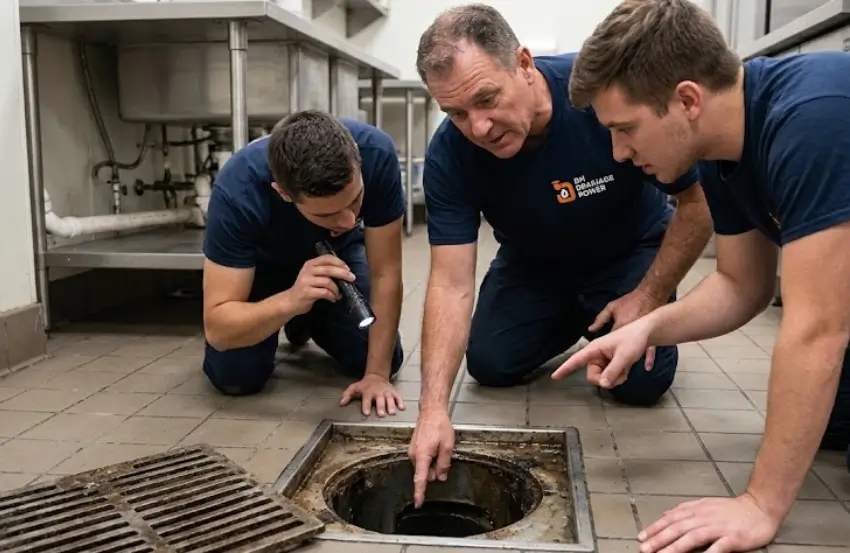
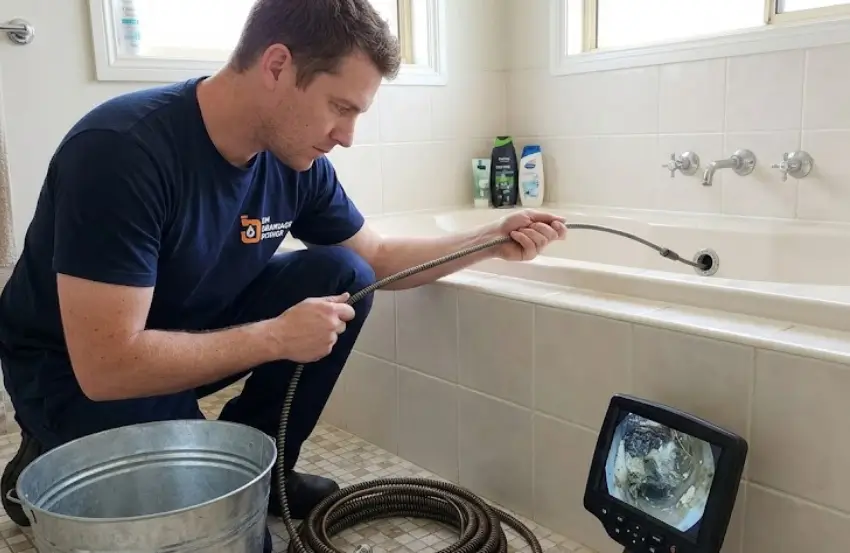
During a CCTV drainage inspection, a camera is guided through accessible sections of the drainage system. The recorded images allow an engineer to examine visible pipe surfaces, joints, deposits, obstructions and structural defects.
A survey report may identify the pipe material alongside information such as:
- Pipe diameter and approximate inspected length
- Direction of water flow
- Changes in pipe material
- Cracks, fractures or displaced joints
- Root intrusion or other obstructions
- Signs of deformation or deterioration
- Standing water or evidence of poor drainage
- The position and severity of recorded defects
Material identification provides context for interpreting the report. For example, a displaced joint in an older clay drain may require a different investigation from deformation within a pitch fibre pipe.
However, CCTV footage does not always establish the exact material with certainty. Deposits, poor visibility or similar-looking pipe surfaces can make identification difficult. The survey findings should clearly distinguish confirmed observations from suspected material types.
Readers unfamiliar with the inspection process can explore DH Drainage Power’s guide to CCTV drain surveys in London.
What Are the Different Types of Drain Pipe Materials?
Several materials have been used in UK drainage systems over time. Their suitability depends on the pipe’s intended application, installation, loading conditions and applicable standards.
1. Vitrified Clay Drainage Pipes
Vitrified clay pipes are common in older underground drainage systems and remain a recognised drainage material.
They are manufactured from fired clay and provide a hard, chemically resistant internal surface.
Clay pipes can perform effectively for many years when properly installed and maintained. Their rigid construction, however, means they do not flex in the same way as some modern plastic pipes.
Potential defects include:
- Cracks caused by ground movement or external loading
- Misaligned or displaced joints
- Root entry through defective connections
- Fractures or localised pipe damage
Finding clay in a survey report does not automatically indicate a problem. The important question is whether the pipe remains structurally sound and allows wastewater to flow without obstruction.
2. Plastic Drainage Pipes: uPVC and Polypropylene
Plastic drainage pipes are widely used in modern drainage installations.
Two materials commonly referenced in drainage specifications are unplasticised polyvinyl chloride (uPVC) and polypropylene (PP).
Their advantages can include corrosion resistance, relatively low weight and smooth internal surfaces.
Nevertheless, plastic pipework can still develop defects.
Improper bedding, excessive loading, incorrect joint installation or ground movement may contribute to deformation, separation or restricted flow.
When a survey identifies plastic pipework, the engineer should assess the condition of the pipe and its connections rather than assume it is trouble-free because it is a modern material.
3. Cast Iron Drainage Pipes
Cast iron has historically been used for soil, waste and drainage systems, particularly in older buildings.
It is strong and durable, but prolonged exposure to moisture and certain environmental conditions can cause corrosion.
A survey may reveal internal roughness, heavy deposits or deterioration associated with older metallic pipework.
Cast iron is particularly relevant when investigating ageing building drainage systems, although underground drainage arrangements vary between properties.
Where corrosion is suspected, the survey findings may need to be supported by further assessment to establish the pipe’s remaining structural condition.
4. Pitch Fibre Drainage Pipes
Pitch fibre pipes were used in some older UK drainage installations.
They were manufactured using fibre-based material impregnated with bituminous substances.
Unlike rigid clay pipes, pitch fibre can be vulnerable to deformation under certain conditions.
The pipe may gradually lose its original circular shape, restricting the passage of wastewater.
A survey may identify:
- Oval or flattened pipe sections
- Reduced internal diameter
- Distorted pipe walls
- Repeated blockage locations
- Structural changes along the pipe run
Not every pitch fibre pipe requires immediate replacement. The decision depends on its condition, the severity of deformation, drainage performance and the suitability of any proposed intervention.
Because deformation can indicate a structural issue, persistent problems should be assessed professionally rather than repeatedly cleared without investigating the cause.
5. Concrete Drainage Pipes
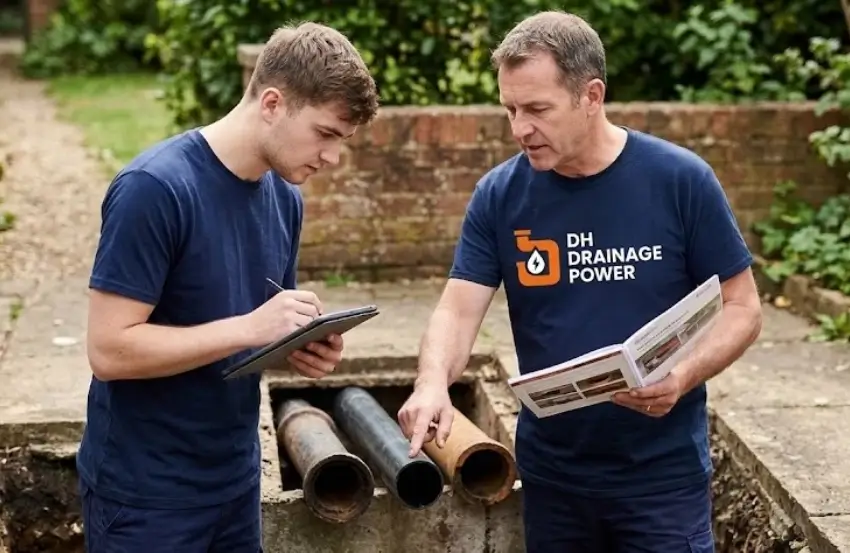
Concrete pipes are used in various drainage applications, including larger underground drainage systems.
Their performance depends on factors such as manufacturing standards, installation, surrounding ground conditions and the wastewater being carried.
Potential defects can include cracking, joint displacement, surface deterioration and damage associated with external loading.
Concrete pipes should not automatically be considered unsuitable simply because they are older. As with other pipe materials, the survey should identify actual defects and their significance.
The UK Government’s Approved Document H: Drainage and Waste Disposal provides official guidance covering drainage design, materials, protection and installation requirements in England.
Drain Pipe Materials Comparison Table
The following table explains how common pipe materials may appear in drainage survey reports.
| Pipe material | Typical characteristics | Possible survey findings | Main consideration |
|---|---|---|---|
| Vitrified clay | Rigid, hard internal surface | Cracks, displaced joints, root entry | Joint and structural condition |
| uPVC | Lightweight, corrosion-resistant plastic | Misaligned joints, deformation, damage | Installation and external loading |
| Polypropylene | Plastic material with corrosion resistance | Joint defects, distortion, obstruction | Pipe specification and support |
| Cast iron | Strong metal pipework | Corrosion, deposits, rough surfaces | Extent of deterioration |
| Pitch fibre | Older fibre-based material | Flattening, ovality, deformation | Structural stability and capacity |
| Concrete | Rigid material used in varied applications | Cracks, displaced joints, deterioration | Loading and structural condition |
Important: This comparison is a general guide. The presence of a particular material does not prove that the drain is defective or establish which repair method should be used.
Why Does Pipe Material Matter When Interpreting Survey Results?
Pipe material helps engineers understand the possible behaviour of a drainage system.
However, the material and the defect must be considered together.
A clay drain with an intact structure may need no significant intervention, while a relatively new plastic drain with severe deformation may require further investigation.
Understanding Structural Strength
Different materials respond differently to external loads and ground movement.
Rigid pipes, such as clay and concrete, may crack when subjected to stresses beyond their design capacity.
Flexible pipe systems depend on appropriate installation and surrounding soil support to maintain their shape.
This distinction matters when the report identifies fractures, displacement or deformation.
Understanding Joint Problems
Drainage systems contain joints that connect individual pipe sections.
Poorly aligned or damaged joints can create gaps where groundwater or tree roots may enter.
They can also create an internal obstruction that traps debris.
The survey should identify the actual joint defect rather than assuming that all joints in a particular pipe material are unreliable.
Understanding Internal Surface Conditions
Grease, scale, sediment and other deposits can accumulate inside drainage pipes.
Some deteriorated surfaces may retain deposits more readily, but material alone does not explain every blockage.
Kitchen waste, inappropriate disposal practices, insufficient flow and structural defects can all contribute to recurring drainage problems.
How Can You Read Pipe Material Codes in a Drainage Survey?
Drainage survey reports may contain material abbreviations.
These abbreviations can help readers interpret technical observations, but coding conventions are not necessarily identical across every report or inspection system.
Examples of material descriptions include:
| Material description | Meaning |
|---|---|
| VC | Vitrified clay |
| PVC or uPVC | Polyvinyl chloride or unplasticised PVC |
| PP | Polypropylene |
| CI | Cast iron, where used in the report’s coding system |
| Concrete | Concrete pipework |
| Pitch fibre | Fibre-based drainage pipe material |
Always refer to the survey report’s legend or coding key before interpreting an abbreviation.
Some reports use more specific material designations, and an abbreviation may have a different meaning depending on the reporting format.
What Else Should You Check in the Report?
Start by locating the section showing the pipe’s material, size and direction.
Then examine the recorded observations to determine whether the report identifies a defect.
Pay attention to:
- Defect location: Where the problem appears along the inspected section.
- Defect description: Whether the issue involves cracking, roots, obstruction or deformation.
- Severity: How significantly the defect may affect drainage performance or structural condition.
- Recommended action: Whether monitoring, clearance, further investigation or repair is suggested.
- Inspection limitations: Whether the camera could inspect the full pipe run.
A report identifying an old material without any associated defect does not necessarily justify extensive repairs.
What Warning Signs Suggest a Drainage Pipe May Be Deteriorating?
Property owners generally cannot identify underground pipe materials without an inspection or reliable records.
However, several symptoms may indicate problems within the drainage system.
Common Warning Signs
- Slow drainage affecting several fixtures
- Blockages returning after clearance
- Gurgling sounds from toilets or sinks
- Persistent unpleasant drainage smells
- Wastewater backing up into fixtures
- Water collecting around external drains
- Evidence of drainage leakage or ground disturbance
These symptoms are not exclusive to damaged pipes. Grease accumulation, foreign objects, root intrusion and other obstructions can produce similar effects.
A professional inspection can help distinguish a removable blockage from an underlying structural defect.
For further context, read what drainage engineers check during fault finding.
Can Old Drain Pipe Materials Cause Repeated Blockages?
Age alone does not cause every drainage blockage.
However, older drainage systems may contain deteriorated joints, deformation, corrosion or fractures that make blockages more likely.
For example, a partially displaced clay joint can catch waste passing through the pipe. Similarly, a deformed pitch fibre section may reduce the internal space available for wastewater.
Removing the immediate obstruction may restore flow temporarily, but the underlying structural condition can remain unchanged.
This is why recurring blockages deserve more attention than isolated drainage incidents.
When Should You Request a CCTV Inspection?
Consider professional investigation when blockages repeatedly affect the same drain, several fixtures back up together or previous clearance work has not resolved the problem.
A CCTV inspection can help establish whether visible pipe damage is contributing to the issue.
The footage may also provide information that helps an engineer decide whether additional testing or investigation is required.
Does Every Old Drainage Pipe Need Replacing?
No. Older drainage pipes can remain serviceable when they are structurally sound and operating correctly.
A recommendation to replace pipework should consider the condition of the actual drain rather than its age or material alone.
For example, minor deposits inside an otherwise sound clay pipe may require maintenance rather than replacement.
By contrast, extensive deformation, repeated failures or significant structural damage may justify more substantial intervention.
What Factors Influence the Repair Decision?
A drainage specialist should consider:
- The type and extent of damage
- Pipe material and diameter
- Accessibility of the affected section
- Whether the pipe has lost its structural integrity
- The severity and frequency of blockages
- The condition of neighbouring pipe sections
- Whether the proposed repair is suitable for the existing material
Not every pipe can be repaired using the same technique.
Where structural damage is suspected, a detailed assessment helps avoid unnecessary work and ensures the proposed solution addresses the underlying problem.
Learn more about underground drain repairs in London.
How Do Drainage Materials Affect London Properties?
London contains buildings constructed and altered across different periods, so drainage systems can include a mixture of older and newer pipe materials.
An older property may contain clay underground drains alongside more recent plastic connections.
Extensions, refurbishment work and changes to building layouts can also introduce different materials within the same drainage network.
This makes it important to examine each inspected section independently rather than assume that the entire system is made from one material.
Considerations for Homeowners and Landlords
A drainage survey can provide useful evidence when investigating recurring blockages or assessing the condition of underground pipework.
Landlords and property managers may also find the information valuable when prioritising maintenance and documenting defects.
Where pipe ownership is unclear, responsibility should be checked before arranging substantial work.
Thames Water’s sewer pipe responsibility guidance explains how responsibility can differ between private drains and public or shared sewers within its service area.
Considerations for Commercial Properties
Commercial premises may have more complex drainage arrangements or higher wastewater volumes than individual homes.
For restaurants, offices, shops and other commercial buildings, drainage reports can support maintenance planning and investigations into repeated disruption.
Pipe material is only one part of the assessment.
Operational conditions, wastewater characteristics, structural defects and the accessibility of the drainage network also matter.
DH Drainage Power serves residential and commercial customers throughout London and surrounding areas, including Hounslow, Croydon, Wembley and Kingston upon Thames.
How Can Property Owners Protect Their Drainage Pipes?
Preventative maintenance helps reduce avoidable blockages and makes it easier to identify problems before they become more disruptive.
Practical Drainage Maintenance Steps
- Keep fats and oils out of sinks. Allow cooking grease to cool and dispose of it appropriately rather than pouring it into drainage pipes.
- Avoid flushing unsuitable products. Wet wipes, sanitary products and other non-flushable items can obstruct drainage systems.
- Keep external gullies clear. Remove visible leaves and surface debris when it is safe to do so.
- Investigate recurring problems. Repeatedly clearing a blockage without checking its cause may leave a structural defect unresolved.
- Retain drainage records. Keep CCTV reports, repair documents and drainage plans where available.
- Seek advice before major alterations. Building work near underground drains can require investigation and relevant permissions.
Avoid using aggressive chemical drain cleaners as a substitute for diagnosing persistent problems. Never mix drainage chemicals.
Do not enter manholes, inspection chambers or confined drainage spaces. Leave specialist access and investigation to appropriately equipped professionals.
When Should You Contact a Drainage Specialist?
Professional assistance is appropriate when a drainage survey identifies significant structural defects, or when ongoing symptoms suggest that the drainage system is not functioning correctly.
Urgent attention is particularly important when wastewater is overflowing, sewage is entering occupied areas or essential drainage facilities cannot be used safely.
If wastewater is backing up, reduce use of connected appliances and fixtures where safe, keep people away from contaminated areas and seek professional advice.
DH Drainage Power provides drain clearance, CCTV inspections, fault finding and drain repairs across London and surrounding areas.
The team can help investigate problems affecting different drainage pipe materials and explain possible next steps based on the observed condition.
Frequently Asked Questions About Drain Pipe Materials
1. What is the most common material used for modern drainage pipes?
Plastic materials such as uPVC and polypropylene are widely used in modern underground drainage installations. They offer corrosion resistance and relatively straightforward handling when installed correctly. However, the appropriate material depends on the application, loading conditions and relevant standards. Existing UK drainage networks may also contain clay, concrete and other materials.
2. Can a CCTV drain survey identify the exact pipe material?
A CCTV survey can often identify visible characteristics associated with particular pipe materials, especially when the interior surface and joints are clearly visible. However, deposits, poor lighting or similar appearances can make identification uncertain. Where the exact material is important for repairs or modifications, further verification may be necessary.
3. Are clay drainage pipes still suitable for older houses?
Yes. Clay drainage pipes can remain functional for many years when their structure and joints are sound. The fact that a property contains clay drains does not automatically mean replacement is necessary. A survey should assess cracks, displaced joints, root intrusion and drainage performance before recommending any significant work.
4. Why are pitch fibre pipes mentioned in drainage survey reports?
Pitch fibre pipes may be highlighted because some older installations are susceptible to deformation and a reduction in internal diameter. A survey can help establish whether the pipe has retained its shape or developed defects. The presence of pitch fibre alone does not prove that immediate replacement is required.
5. What does a change in pipe material mean during a CCTV inspection?
A change in material may indicate alterations, previous repairs, an extension or different installation periods within the drainage network. It is not necessarily a defect. However, the connection between two materials should be inspected for alignment, joint condition and possible restrictions to wastewater flow.
6. Does a damaged pipe always need to be excavated?
Not necessarily. The appropriate repair depends on the nature of the defect, pipe condition, location and access. Some problems may be addressed through suitable non-excavation methods, while others require more extensive work. A drainage specialist should assess the findings before recommending a particular repair.
7. Who is responsible for repairing old underground drainage pipes?
Responsibility depends on whether the affected pipe is a private drain, public sewer or qualifying shared or lateral sewer. Property owners are generally responsible for private drainage serving their property, while sewerage companies maintain public networks within their areas. Ownership should be confirmed before arranging significant repairs.
Conclusion: Understanding Drain Pipe Materials Before Making Repair Decisions
Understanding drain pipe materials makes a CCTV drainage survey report easier to interpret.
Clay, plastic, cast iron, pitch fibre and concrete pipes have different characteristics, but no single material should be judged without considering its actual condition.
The most useful survey findings are those that identify visible defects, explain their significance and support proportionate maintenance or repair decisions.
For homeowners, landlords and businesses across London and Greater London, professional drainage advice can help clarify whether a problem requires clearance, monitoring, further inspection or repair.
Need help with a drainage problem or an unclear CCTV survey finding?
Contact DH Drainage Power for professional drainage assistance.
- Phone: +447897041092
- Website: https://dhdrainagepower.co.uk/
- Contact: https://dhdrainagepower.co.uk/contact/
- Emergency drainage support: Available 24/7
Call today or submit an enquiry through the contact page to discuss your drainage concerns.